Artículo: Common Small Rug Sizes: 2x3, 3x5, 4x6 and Where Each Fits
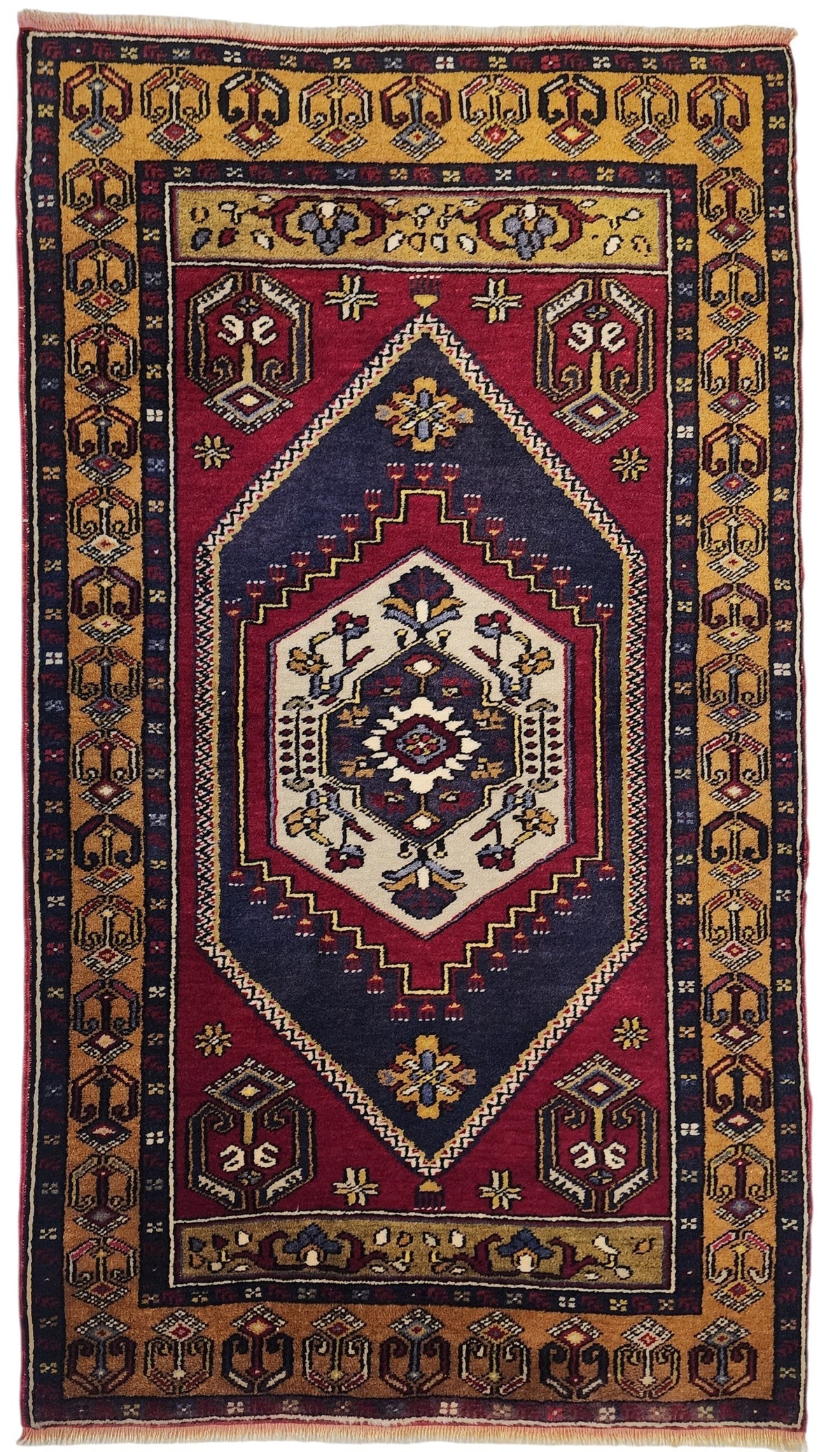
Common Small Rug Sizes: 2x3, 3x5, 4x6 and Where Each Fits
Quick answer: The most common small rug sizes are 2x3 ft (60 x 90 cm), 2x4 ft (60 x 120 cm), 3x5 ft (90 x 150 cm), 4x6 ft (120 x 180 cm) and 5x7 ft (150 x 210 cm). Use 2x3 for doors and sinks, 3x5 for entries and desks, and 4x6 or larger for bedsides and reading corners.
Which small rug sizes are standard?
"Small" has no legal definition, but the trade settles around a handful of footprints. Anything with its longest side under about 5 feet (150 cm) is usually called small, and pieces under 3 feet (90 cm) are often called mini or doormat size. On our own shelves we group them the same way: mini rugs and small rugs.
Because every vintage Turkish rug is hand-woven, the real measurements drift a few inches from the round number. A rug sold as 3x5 may measure 2'10" x 4'11". That is normal, and it is why we always list exact dimensions in feet and centimetres.
| Common name | Feet | Centimetres | Typical use |
|---|---|---|---|
| Mini / doormat | 2 x 3 ft | 60 x 90 cm | Entry, sink front, stool or chair seat |
| Narrow accent | 2 x 4 ft | 60 x 120 cm | Kitchen counter, short hallway, beside a bed |
| Accent | 3 x 5 ft | 90 x 150 cm | Entryway, office chair area, end of a sofa |
| Small area | 4 x 6 ft | 120 x 180 cm | Bedside, reading corner, small bedroom |
| Upper small | 5 x 7 ft | 150 x 210 cm | Under a small coffee table, home office |
Some retailers stretch "small" up to 5x8. For buying purposes we would call 5x7 the edge: it is large enough to anchor a small seating group, but still light enough to move on your own.
What are the most common sizes, one by one?
2 x 3 ft (60 x 90 cm)
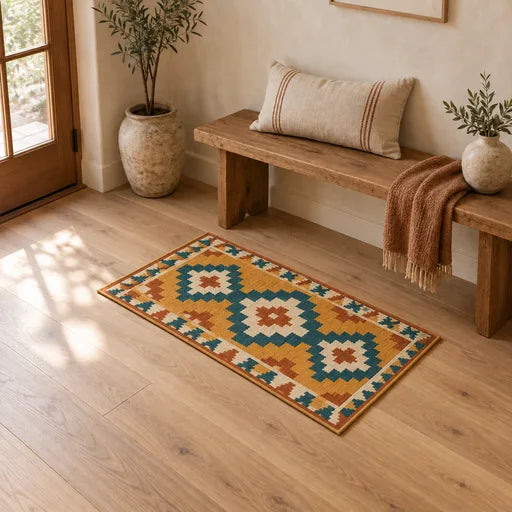
The smallest size most people buy. It fits in front of a door, a kitchen sink or a vanity, and can also be used on a wooden chair or a bench as a seat cover. It is too small to sit under furniture legs, so treat it as a standalone object. For example, Eulalia, a vintage Kayseri in 2x3, is the kind of piece that suits an entry or a bathroom.
2 x 4 ft (60 x 120 cm)
This is a short runner proportion. It works in front of a kitchen counter, along a galley bench, or beside a single bed. Leave at least 3 inches (8 cm) of bare floor to each side so it reads as a deliberate rug rather than something dropped there.
3 x 5 ft (90 x 150 cm)
Probably the most flexible small size. Place it inside an entry door, under a desk chair, or in front of a chest of drawers. It is the size most people picture when they say "accent rug." Our vintage Yahyalı Hekuba is a 3x5 example.
4 x 6 ft (120 x 180 cm)
Large enough to hold the front legs of an armchair, or to sit beside a double bed where you step out in the morning. In a small bedroom, two of these, one on each side, often look better than one oversize rug.
5 x 7 ft (150 x 210 cm)
This is the biggest of the small group. In a compact living room it can sit under a coffee table with the front legs of the sofa on its edge. In a 10 x 10 ft (3 x 3 m) bedroom it can sit under the foot of the bed.
How do you choose a small rug size for each spot?
Start from the furniture, not the catalogue. Measure the open floor, then decide how much of it you want to leave bare. These rules of thumb work for nearly every room:
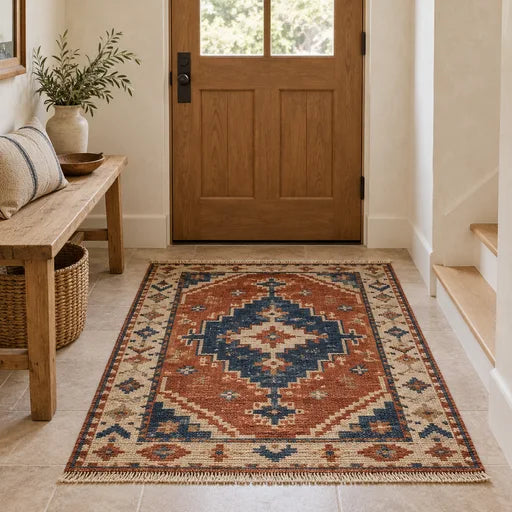
- Entryway: leave room for the door to swing clear of the rug, and keep it a few inches narrower than the opening. Pick 2x3 or 3x5.
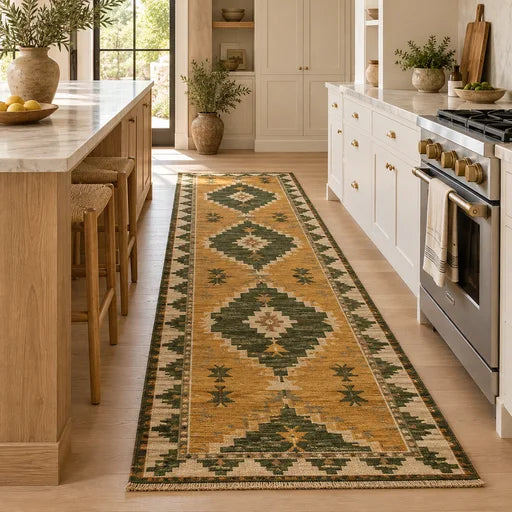
- Kitchen: 2x3 at the sink, 2x4 at a counter. For a long galley, a runner is better; see our guide to kitchen runner rug sizes.
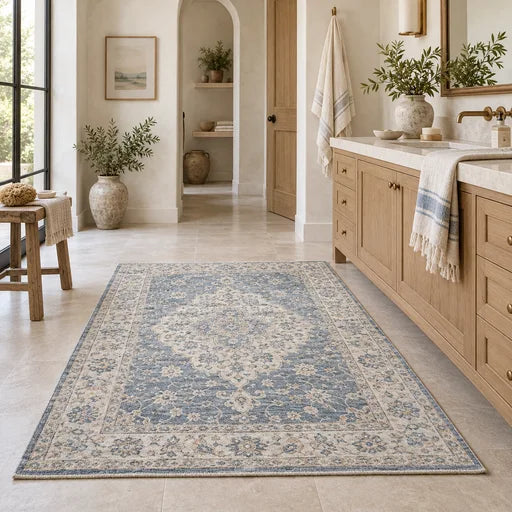
- Bathroom: 2x3 is plenty. Lift the rug regularly to let the floor beneath it dry.
- Bedside: 2x4 or 3x5 on each side, extending at least 24 inches (60 cm) out from the bed so your feet land on it.
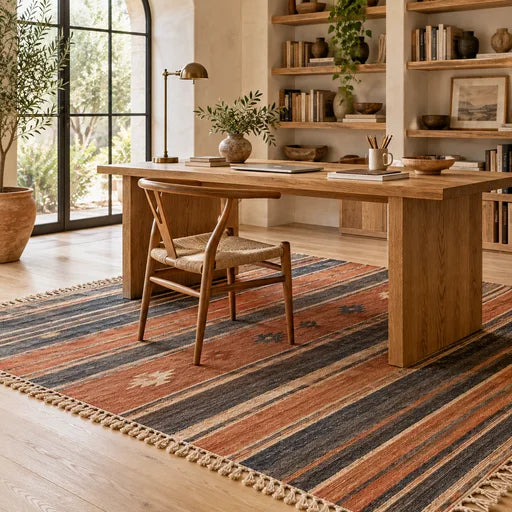
- Desk or office chair: 3x5 or 4x6, so the chair can roll without catching on an edge.
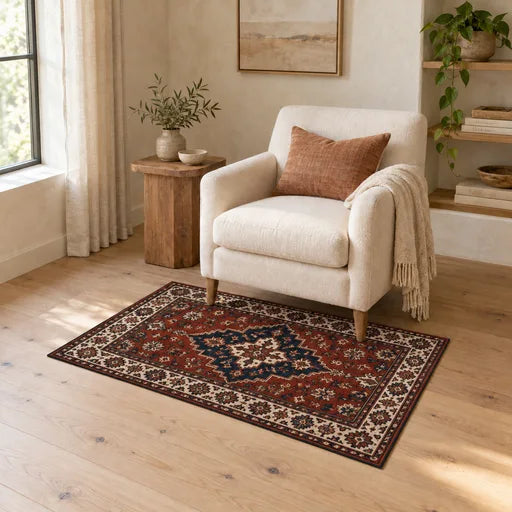
- Reading corner: 4x6 under an armchair, with at least the front two legs on the rug.
If you are unsure how a small piece fits the rest of a room's layout, our overview of choosing rug size for every room covers the bigger sizes as well.
Can a small rug go under furniture?
Yes, but only in two cases. First, a 5x7 can sit under the front legs of a sofa and armchairs in a very small room. Second, a 3x5 or 4x6 can sit under the foot of a bed, running sideways. Anything smaller floats and can look like a mistake.
A common error is a rug that is just a little too small for the group. A rug that does not reach any furniture looks like a postage stamp. If your room needs more coverage than 5x7, move up to our medium rugs instead of trying to force a small one to do a big job.
What should you check before buying a small vintage rug?
Small rugs often sit at the door and by the bed, where they get the hardest wear. A few checks will save you later:
- Exact size. Compare the listed centimetres to a tape on your floor. Use painter's tape to mark the outline for a day.
- Pile condition. Wool pile should be even. Worn patches are not always a flaw in a vintage piece, but they should be where you expect them.
- Edges and ends. The side cords and fringes should be intact or neatly secured.
- Foundation. Turn a corner over: the knots should be tight and regular, with no loose threads or open gaps.
- Floor surface. A thin pad under a small rug prevents slipping on wood or tile.
For pads, thickness and which type to choose, see our rug pad guide. For reading dimensions on a listing, see how to read vintage rug dimensions.
Why are small Turkish rugs a good choice?
Small vintage pieces are the easiest way to try a hand-knotted rug. They cost less than large ones, they are simple to move and clean, and a pattern that feels too strong across a whole room works well in a small dose. Every one is one of a kind, so you will not see your 2x3 in your neighbour's hallway.
Wool is also a practical fibre for the places where small rugs go. It is naturally resilient, and a shake outdoors removes much of the surface dust. Rotate the rug every few months so that wear spreads evenly.
Many small pieces we see come from Kayseri, Yahyalı, Konya and Işıklar weaving. For a quick browse by size, the mini rugs and small rugs collections list exact measurements for each rug.
How can you test the size before you buy?
Cut a sheet of brown paper, or tape newspaper pages together, to the rug's exact dimensions. Lay it where the rug will go and live with it for a day or two. Walk through the room, open the door, pull out the chair. If anything catches, adjust the size or position before you order.
When the paper shape looks too small, it usually is. Size up one step rather than splitting the difference. When it looks slightly large, check clearances rather than shrinking it: a bit of overlap with furniture is fine, a blocked door is not.
Here is a simple order of work:
- Measure the open floor in feet and centimetres.
- Mark the candidate size with painter's tape or paper.
- Check that doors, drawers and chairs move freely.
- Pick a pad that is about 1 inch (2.5 cm) smaller than the rug on each side.
- Choose the pattern last, once the size is settled.
All of our rugs ship free worldwide, import duties are pre-paid for the US, UK, EU and Canada, and you have 14 days for returns, so a trial in your own room carries little risk.
How do small rugs combine with one another?
Two small rugs often work better than one big one in a long or awkward space. Place two 3x5 rugs side by side with 4 to 6 inches (10 to 15 cm) between them in a wide entry, or set a pair of 2x4 pieces on either side of a bed. Keep the pattern scale similar but vary the colours slightly, so that they look related rather than duplicated.
Layering is a different technique: a small rug laid on top of a larger neutral one adds contrast. Our guide to layering rugs explains how to keep the bottom rug flat and the top one anchored.
Finally, remember that a small rug is a design accent as much as a floor covering. In a plain room, one strong red, blue or green Anatolian piece can set the whole colour scheme. In a busy room, choose a quieter one from our neutral rugs. Either way, measure first, then fall in love with a pattern.
A last tip on placement: set the rug parallel to the longest wall or to the furniture it serves, and keep the corners square. A rug set at an angle can look deliberate in a large hall, but in a small space it tends to look like a mistake. Square placement also makes it easier to keep the pad hidden and the edges flat, which matters most at doorways where people walk over the rug many times a day.
Pieces from our collection
Every piece below is one of a kind and in stock today:
- Hekuba — Vintage Yahyalı Rug, 3x5
- Amaltheia — Vintage Yahyalı Rug, 2x4
- Eulalia — Vintage Kayseri Rug, 2x3
- Selçuka — Vintage Konya Rug, 2x4
Frequently asked questions
What is the most popular small rug size?
The 3x5 ft (90 x 150 cm) is the usual all-rounder, because it fits entryways, desks and bedsides without crowding. The 2x3 ft (60 x 90 cm) is the next most common, mainly for doors, sinks and benches. Pick by the spot, not by popularity, and measure the floor first before you commit to any size.
Is a 4x6 rug considered small?
Yes. Most shops count 4x6 ft (120 x 180 cm) as the top end of small rugs or the bottom end of medium. It suits a bedside, a reading chair or a short entry, but it will not anchor a full seating group in a living room of normal size.
How much floor should show around a small rug?
Leave at least 3 inches (8 cm) of bare floor on each side of a narrow rug, and a little more in a room so the layout looks balanced. In an entryway, make sure the door opens fully over the rug without catching on the edge or the pile.
Do vintage Turkish rugs come in exact standard sizes?
Rarely. Each is woven by hand, so a rug sold as 3x5 may be a few inches off in either direction. We list the real measurements in feet and centimetres on every product page, so you can compare them against your floor with a tape measure before ordering.
Do small rugs need a rug pad?
Usually, yes, especially on wood, tile or laminate. A thin non-slip pad stops the rug from creeping and protects the floor beneath it. Pick a pad about 1 inch (2.5 cm) smaller than the rug on every side so that it stays hidden and the edges lie flat.
Written by the team at Heritage Nomadic Art Gallery in Sultanahmet, Istanbul, the gallery behind TurkishRug.com, where every rug and pillow is chosen, washed and photographed by hand. Last updated November 6, 2026.