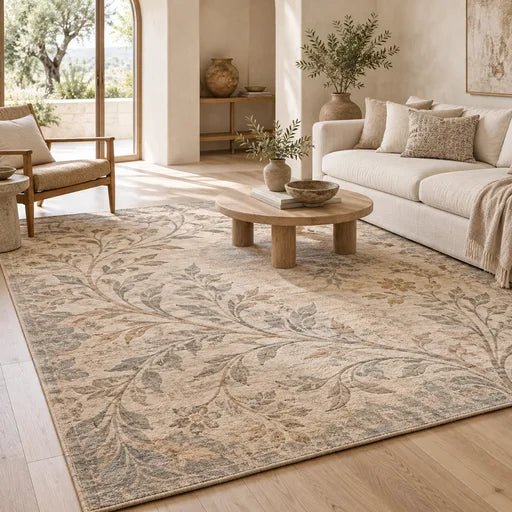
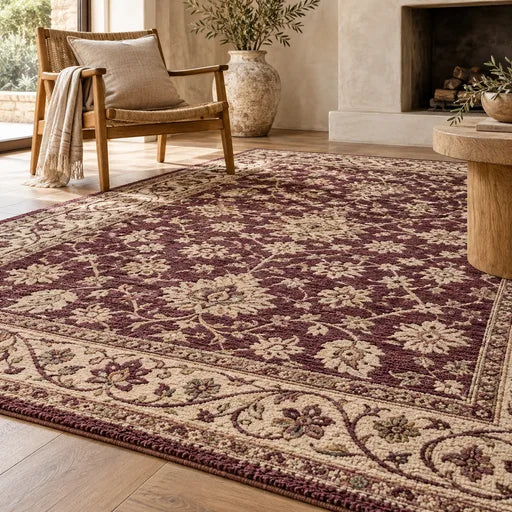

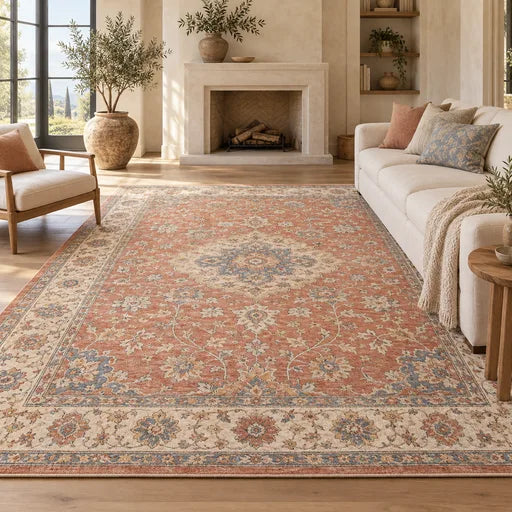
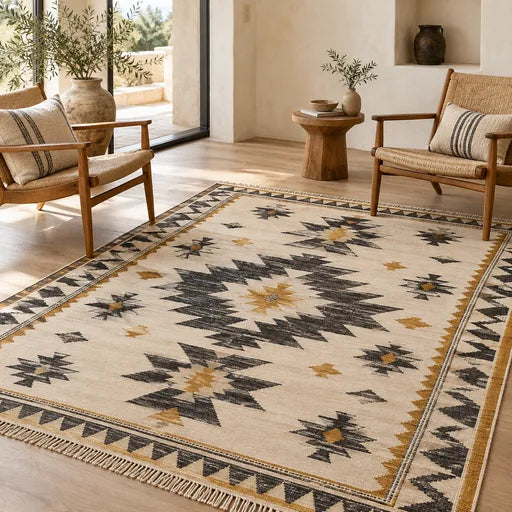
Article: Rug for Bedroom Size: What Fits Under a Twin, Queen or King Bed
Rug for Bedroom Size: What Fits Under a Twin, Queen or King Bed
Quick answer: For a bedroom rug, size by the bed: the rug should extend at least 18 inches (45 cm) past both long sides. That means a 5x8 ft rug for a twin or full, a 6x9 or 8x10 ft rug for a queen, and an 8x10 or 9x12 ft rug for a king. Place it under the lower two thirds of the bed.
How big should a bedroom rug be?
The short rule we give customers: the rug should be wide enough that your feet land on wool when you get out of bed, on both sides. In practice that means the rug extends at least 18 inches (45 cm) beyond each long side of the bed, and ideally 24 inches (60 cm). Everything else in this guide is a variation on that one number.
A rug that is too small is the most common bedroom mistake. A 3x5 ft (91x152 cm) rug dropped at the foot of a queen bed looks like a doormat, and a 5x8 ft (152x244 cm) rug pushed under the bed leaves cold floor on both sides. Going one size larger than feels natural in the shop is usually right, because a bed visually hides a lot of rug.
Start by measuring the bed, not the room. Then check the room, because the rug also has to leave a border of bare floor along the walls, ideally 12 to 24 inches (30 to 60 cm), so the room does not look carpeted wall to wall.
What size rug for a twin, full, queen or king bed?
Standard mattress sizes in the US are well established, and they are the starting point for choosing a rug. The table below pairs each bed with the rug sizes we find work best when the rug sits partly under the bed. Sizes are in feet and centimetres.
| Bed | Mattress (approx.) | Rug that works well | Smaller option |
|---|---|---|---|
| Twin | 38x75 in (97x190 cm) | 5x8 ft (152x244 cm) | Two runners, each 2.5x8 ft (76x244 cm) |
| Full | 54x75 in (137x190 cm) | 5x8 or 6x9 ft (183x274 cm) | Runner pair, each 2.5x8 ft |
| Queen | 60x80 in (152x203 cm) | 8x10 ft (244x305 cm) | 6x9 ft (183x274 cm) |
| King | 76x80 in (193x203 cm) | 9x12 ft (274x366 cm) | 8x10 ft (244x305 cm) |
For a queen bed, a 6x9 ft rug gives you only 18 inches (45 cm) on each side if it is centred, which is the minimum. An 8x10 ft rug gives about 34 inches (86 cm) on each side and lets a bedside table sit on or beside the rug. For a king, an 8x10 ft rug leaves roughly 26 inches (66 cm) per side, which is generous enough; a 9x12 ft rug gives you more but needs a large room.
Real vintage rugs rarely come in exact catalogue sizes, because they were woven on village looms to fit a home or a tent, not a retail grid. A "6x9" might be 5 ft 9 in by 9 ft 4 in. Treat the table as a target and allow a few inches either way. Our guide to reading vintage rug dimensions in centimetres and feet explains how to convert and compare.
Should the rug go fully under the bed or only partly?
There are three layouts, and each suits a different room size.
- Fully under the bed. The rug extends past all three free sides. It needs the biggest rug, such as 9x12 ft for a king, but it looks the most settled and keeps every step on wool.
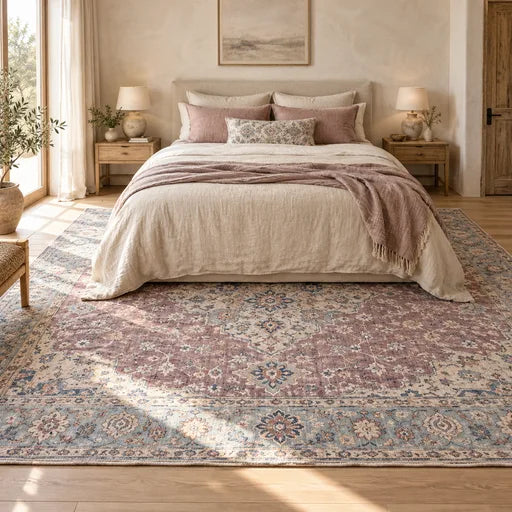
- Under the lower two thirds of the bed. This is our usual recommendation. Position the rug so the bed covers roughly the bottom two thirds of its length, leaving the rug visible at the foot and on both sides. It works with one rug size down from "fully under" and suits most rooms.
- Only at the foot, or beside the bed. Use this when the room is small or the bed has a low frame that sits tight to the floor. Two runners, one each side, are a classic solution for a twin or full bed.
Whichever layout you choose, keep the rug square to the bed. Start the rug about 6 to 12 inches (15 to 30 cm) in front of the headboard wall, so the bed legs rest on the rug and the nightstands sit either fully on it or fully off it. A nightstand with two legs on the rug and two on the floor wobbles.
What size rug for a small bedroom?
In a room around 10x10 ft (305x305 cm), a queen bed already takes most of the floor. Here a 5x8 ft (152x244 cm) rug placed across the lower third of the bed, or two runners of 2.5x8 ft (76x244 cm) either side, does the job without crowding the walls. You can also use a 4x6 ft (122x183 cm) rug at the foot of the bed, but treat it as an accent rather than a base layer.
A good test is to tape the rug's outline on the floor with painter's tape and leave it there for a day. If you have to step over the tape to reach a wardrobe or a door, the rug is too big for the layout, not just the room. Our article on common small rug sizes covers the 2x3, 3x5 and 4x6 ft options in more detail.
If you are unsure between two sizes, go by the exact measurements of the piece, not the label. Every rug in our bedroom rugs collection lists its real size, and because each piece is one of a kind, a size you like will not be reproduced exactly elsewhere.
How do you choose the rug style and pile for a bedroom?
Size gets the rug on the floor; texture and colour make it comfortable. Bedrooms are barefoot rooms, so softness matters more than it does in a hallway.
- Pile rugs (knotted wool) are warm and soft underfoot. A vintage wool rug that has been worn in over decades is typically supple rather than stiff. See our hand-knotted rugs for examples.
- Flatweaves and kilims are thinner and lighter. They suit warm climates and layering, but feel firmer underfoot. Browse our kilim flatwoven rugs if you prefer a lighter weave.
- Soft, low-contrast colours such as faded blue, cream, pink and pale gold read as calm. Strong reds and deep blues work well too, as a single anchor colour under a plain bed.
- Busy patterns hide marks and dust well, which helps by the bed where shoes and pets pass. A medallion or all-over geometric layout also frames a bed neatly.
Pair the rug with the bedding rather than matching it. If the duvet is patterned, choose a rug in two or three of the same tones but at a different scale. If the bedding is plain linen, the rug can carry all the pattern.
Do you need a rug pad under a bedroom rug?
Yes, in almost every case. A rug pad stops slipping, adds a little cushion, and protects the floor and the rug's back. For a bedroom, a pad about 1/4 inch (6 mm) thick is a sensible choice, cut about 1 inch (2.5 cm) smaller than the rug on every side so it does not show. On carpet, see our guide to choosing a rug pad for carpet.
Choose a breathable felt or natural rubber pad rather than a plastic one, which can mark some floor finishes. If you have any doubt, test a small corner first.
Can you put a rug on top of a carpeted bedroom floor?
You can, and many people do. Choose a rug big enough that its edges do not curl, and use a pad designed for carpet, which grips both layers. A flatweave works better than a very thick pile on deep carpet, because the layered height can create a lip that catches toes. For more on stacking pieces, read how to layer rugs like an interior designer.
How do you keep a bedroom rug clean?
Wool is naturally resistant to soil, but a bedroom rug still needs a routine. Vacuum once a week with suction only (turn off the beater bar on pile rugs, or use the hose), and rotate the rug 180 degrees every six months so wear and sunlight are even. Put felt or wide glides under the bed's legs, because narrow feet can dent the pile over time. Blot spills immediately with a clean white cloth and cold water, and never rub.
For the full routine, including stains and when to send a rug to a professional cleaner, see our guide on how to care for a vintage wool rug.
A quick checklist before you buy
- Measure the bed (width and length) and the free floor on each side.
- Decide the layout: fully under, lower two thirds, or at the foot.
- Aim for at least 18 inches (45 cm) of rug past each long side of the bed.
- Keep 12 to 24 inches (30 to 60 cm) of bare floor along the walls.
- Tape the outline on the floor for a day.
- Choose a pile for comfort and a pattern that hides everyday marks.
- Add a thin, breathable pad cut slightly smaller than the rug.
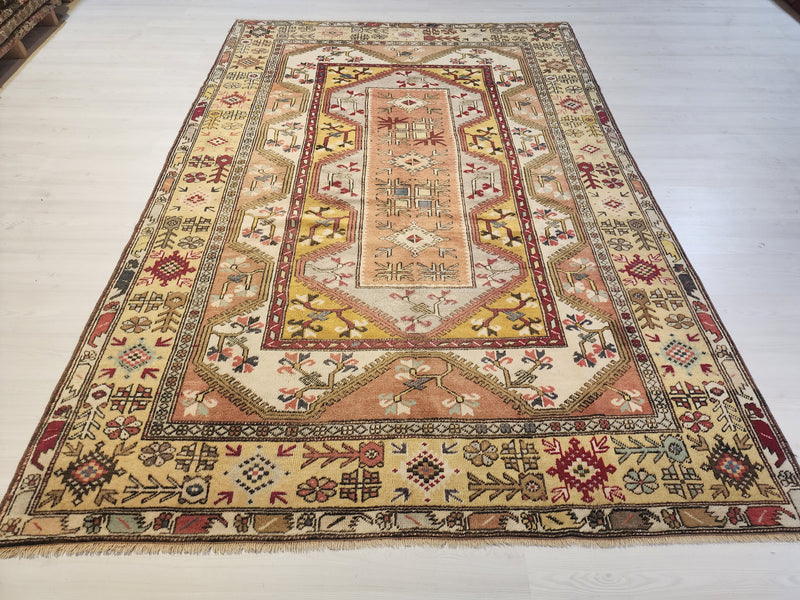
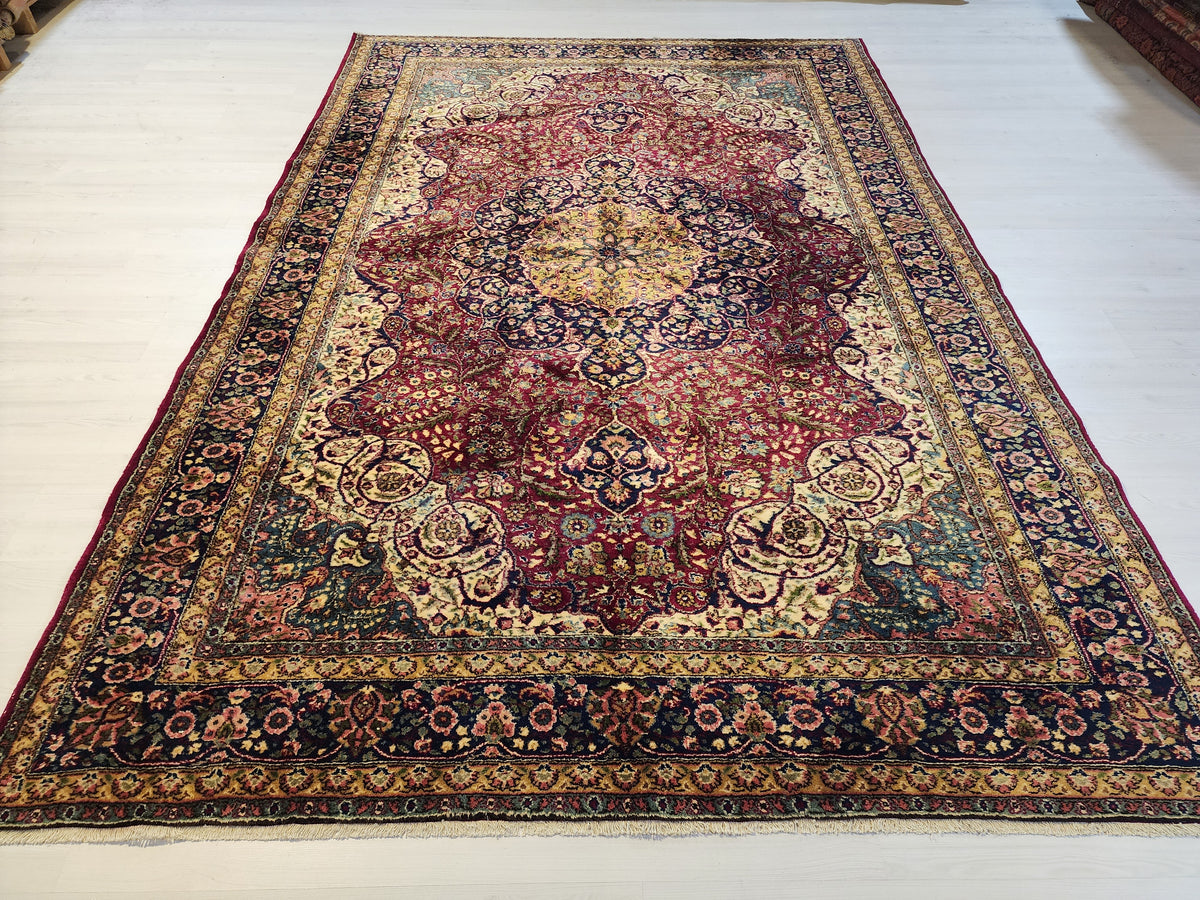
Every rug we list is vintage or antique, handmade in Anatolia, and one of a kind, with free worldwide shipping, import duties pre-paid for the US, UK, EU and Canada, and 14-day returns. Browse our large rugs for queen and king bedrooms and our small rugs for bedside use, such as this vintage Ladik medallion rug, which is 7x10 ft (213x305 cm) and sits well under a queen bed.
Pieces from our collection
Every piece below is one of a kind and in stock today:
- Andronike — Vintage Ladik Medallion Rug, 7x10
- Penthesilea — Vintage Işıklar Rug, 5x7
- Hekuba — Vintage Yahyalı Rug, 3x5
- Magnesia — Vintage Karaova Rug, 6x10
Frequently asked questions
Should a bedroom rug go all the way under the bed?
Not necessarily. Most bedrooms look best with the rug under the lower two thirds of the bed, so it shows at the foot and on both sides. Going fully under needs a much bigger rug, such as 9x12 ft for a king. Only do that if the room has the floor space and you want wool underfoot everywhere.
Is a 5x8 rug big enough for a queen bed?
Usually not if centred, because a queen mattress is 60 inches (152 cm) wide and a 5x8 ft rug is the same width, so nothing shows at the sides. It works only as a foot-of-bed accent or in a very small room. For a queen we suggest 6x9 ft at minimum and 8x10 ft if the room allows.
Can I use two runners instead of one large rug?
Yes. A pair of runners about 2.5x8 ft (76x244 cm), one on each side of the bed, is a classic solution for twin and full beds and for small rooms. Keep them parallel to the bed at the same distance from it, and let them extend a little beyond the foot of the bed.
Do vintage rugs come in standard bedroom sizes?
Rarely exactly. Vintage and antique rugs were woven by hand to fit a home, so a rug sold as 8x10 ft can be a few inches off in each direction. Plan with a tolerance of about 4 inches (10 cm) and check the listed measurements of the actual piece before ordering.
Written by the team at Heritage Nomadic Art Gallery in Sultanahmet, Istanbul, the gallery behind TurkishRug.com, where every rug and pillow is chosen, washed and photographed by hand. Last updated November 14, 2026.