Do You Put a Rug Under a Dining Table? Sizes, Types and Rules
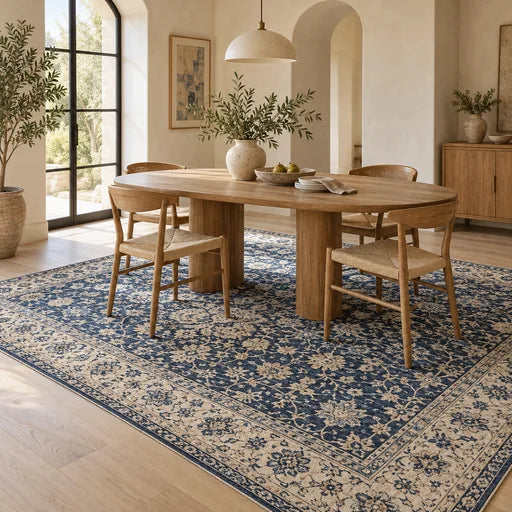
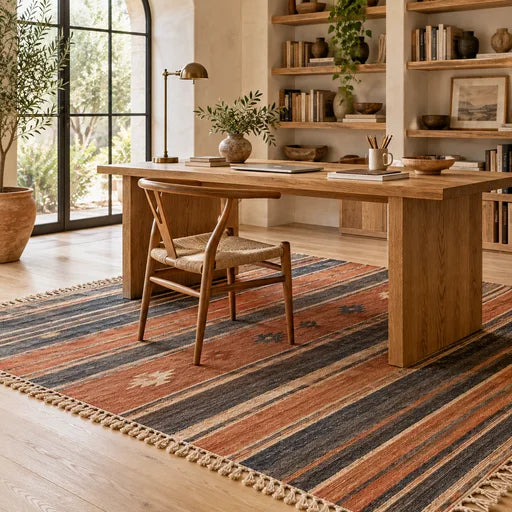
Quick answer: Yes, you can put a rug under a dining table, and it should be large enough that all chair legs stay on it when the chairs are pulled out. Add at least 24 inches (60 cm) to every side of the table. A flatweave kilim or low-pile wool rug is the easiest to live with.
Should You Put a Rug Under a Dining Table?
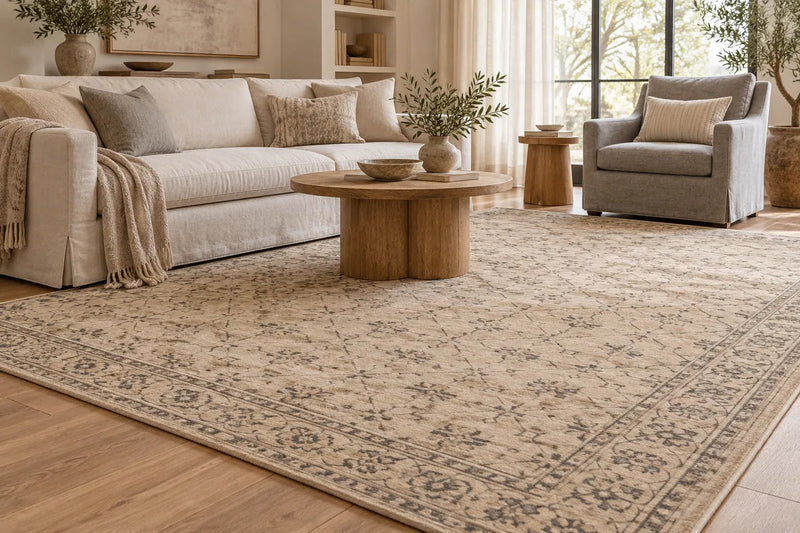
Yes, and it is one of the easiest ways to make a dining room feel finished. A rug defines the eating area, softens the sound of chairs and footsteps, and protects a wood floor from scratches. It also gives a room with a plain table a place for colour and pattern.
There is one rule that matters more than any other: the rug must be big enough that the chairs stay on it, even when they are pulled out. A rug that is too small is worse than no rug at all, because chair legs catch on the edge every time someone sits down.
How Big Should a Rug Be Under a Dining Table?
Measure your table, then add room for the chairs. When a chair is pulled back to sit down, it moves roughly 24 inches (60 cm) beyond the table edge. So the rug should extend at least 24 inches (60 cm) past the table on every side. If you can add a little more, 30 inches (75 cm) is more forgiving.
The sum is simple: table length plus 4 feet (122 cm), and table width plus 4 feet (122 cm). Here is how that works for common tables:
| Table | Table size | Minimum rug size |
|---|---|---|
| Round, seats 4 | 3.5 ft (107 cm) across | 7.5 ft (230 cm) round or square |
| Round, seats 6 | 4.5 ft (137 cm) across | 8.5 ft (260 cm) round or square |
| Rectangular, seats 4–6 | 3 x 5 ft (91 x 152 cm) | 7 x 9 ft (213 x 274 cm) |
| Rectangular, seats 6–8 | 3 x 6 ft (91 x 183 cm) | 7 x 10 ft (213 x 305 cm) |
| Rectangular, seats 8–10 | 3.5 x 8 ft (107 x 244 cm) | 8 x 12 ft (244 x 366 cm) |
Vintage rugs rarely come in exact modern sizes, so treat these as minimums and choose the nearest piece that is slightly larger. Our guide to choosing the right rug size for every room covers the same logic for living rooms and bedrooms, and reading vintage rug dimensions in centimetres and feet explains why listed sizes are approximate.
Check the room, not just the table
Leave at least 8–12 inches (20–30 cm) of bare floor between the rug edge and the walls or the nearest large furniture. A rug that touches the skirting board makes the room look smaller. If the room is tight, measure the space first and look in our dining room rugs or large rugs for pieces that fit.
Which Rug Type Works Best Under Chairs?
Chairs move constantly, so a flat, low surface is the practical choice. Here is how the main types behave under a dining set:
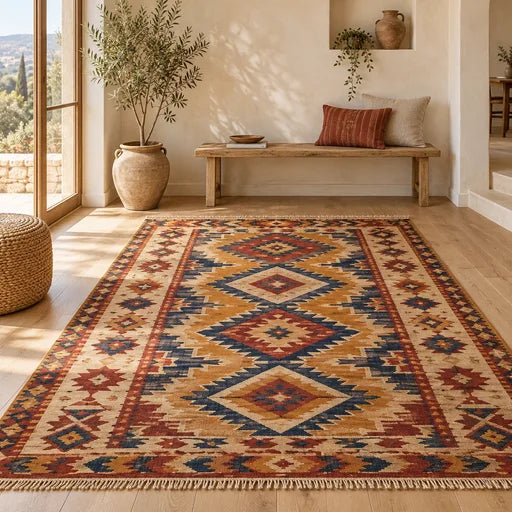
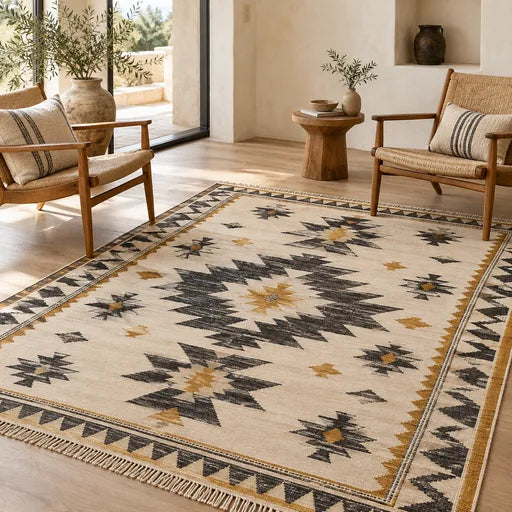
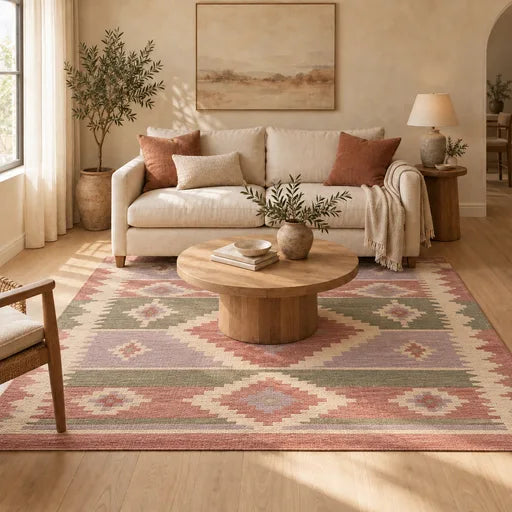
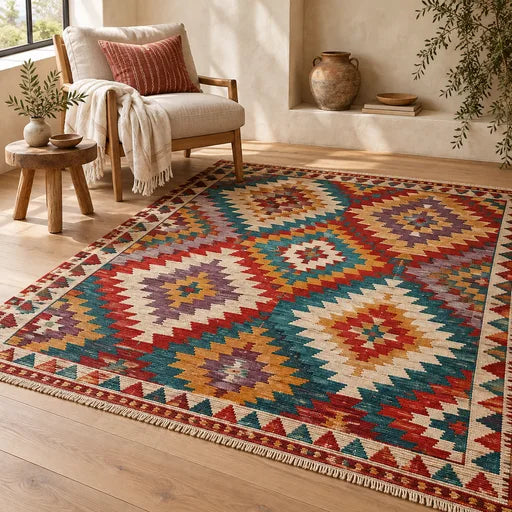
- Flatweave kilim: no pile at all, so chairs slide easily and crumbs sit on top where they can be shaken or vacuumed away. This is our first suggestion for families. See our kilim and flatwoven rugs.
- Low-pile hand-knotted wool: a short, dense pile stands up well to chair legs. Oushak and Anatolian pieces are often woven with a moderate pile that works well. Browse Oushak rugs.
- Tall shaggy pile or tulu: beautiful in a living room, but food and chair legs make it hard work under a table. We would keep these elsewhere.
If you are unsure about the difference between the two main constructions, what a kilim is, and how pile and flatweave differ is a good place to start.
Do Rugs Under Dining Tables Get Dirty?
They do get crumbs and the occasional spill, but wool copes better than most people expect. Wool fibres have a natural coating that slows down liquid soaking in, so a spill that is blotted quickly usually does not set.
- Blot spills straight away with a clean, dry cloth. Press, do not rub.
- Dab with a cloth dampened with cool water, then blot dry.
- Vacuum weekly with the suction head only. Turn off any rotating brush, and keep the vacuum away from fringe.
- Turn the rug 180 degrees every six months so chair wear is shared across the surface.
A busy traditional pattern or a mix of tones in the field hides small marks far better than a plain rug. For deeper cleaning and damage advice, read how to care for a vintage wool rug.
Should You Use a Rug Pad Under the Dining Rug?
Yes. A thin, non-slip pad keeps the rug from creeping when chairs are dragged, and it stops the corners from curling, which is a trip hazard. Choose a thin pad (about 1/8 inch or 3 mm) for a dining room, because a thick, cushioned pad lets chair legs sink in and tilt. Cut the pad about 1 inch (2.5 cm) smaller than the rug on every side so it cannot be seen.
What Colour and Pattern Suit a Dining Room?
Pick the rug first if you can, then choose the table to suit it. A few guidelines we use with customers:
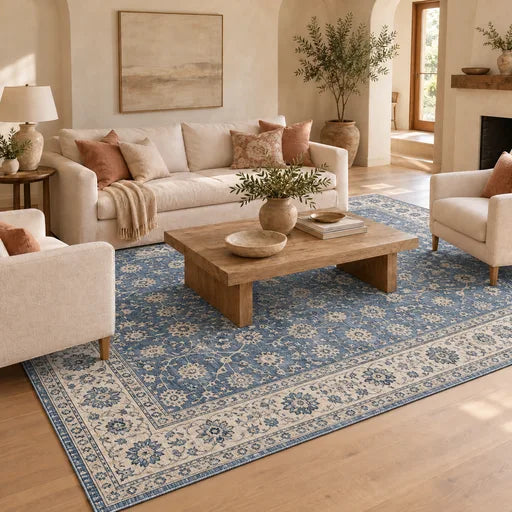
- With a dark wooden table, a rug with some light ground colour (beige, cream, soft blue) stops the room looking heavy.
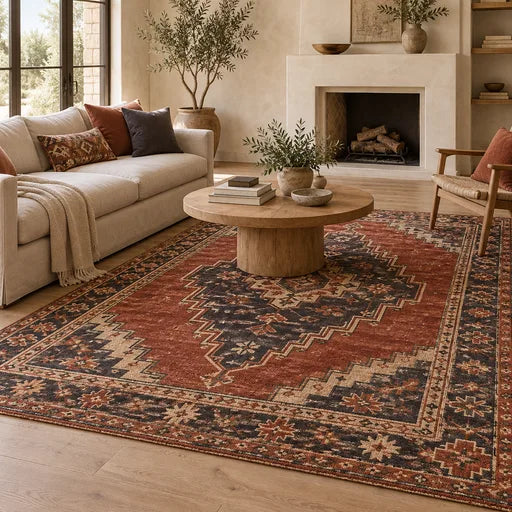
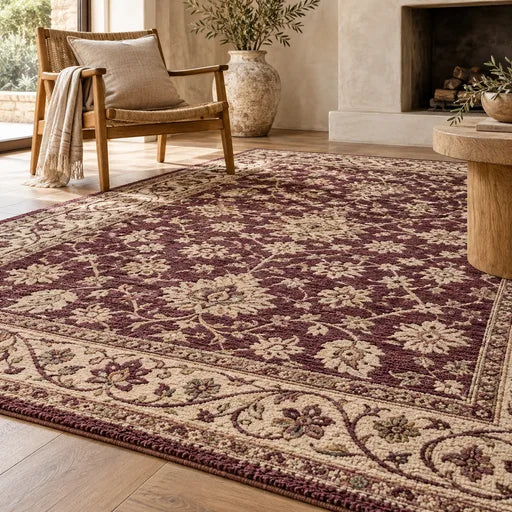
- With a pale or painted table, a deeper red, navy or rust rug gives contrast.
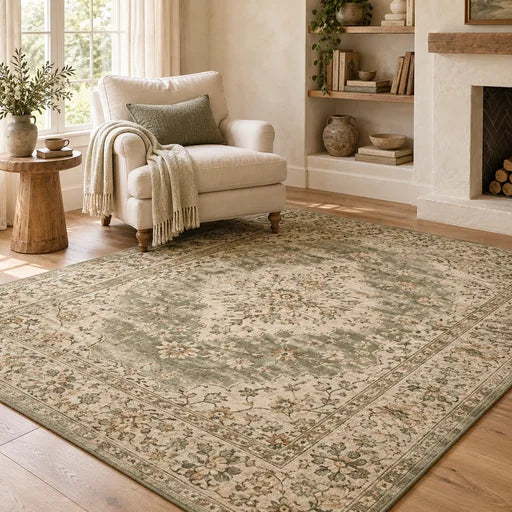
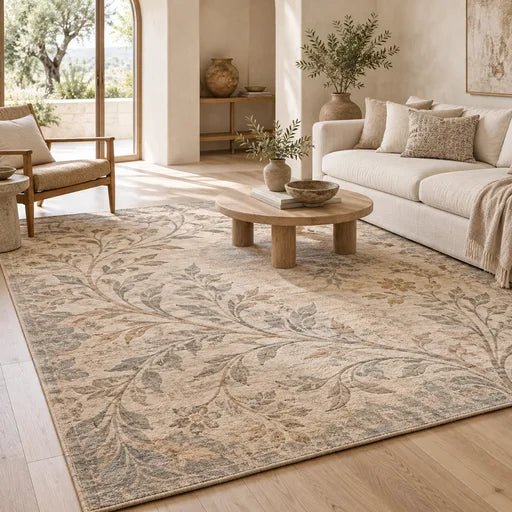
- With a lot of pattern already in the room, a faded or softly toned Oushak-style rug is calmer than a bold geometric.
Our vintage rugs collection lets you filter by colour, so you can see how a few tones look next to your table.
A Few Pieces That Suit a Dining Room
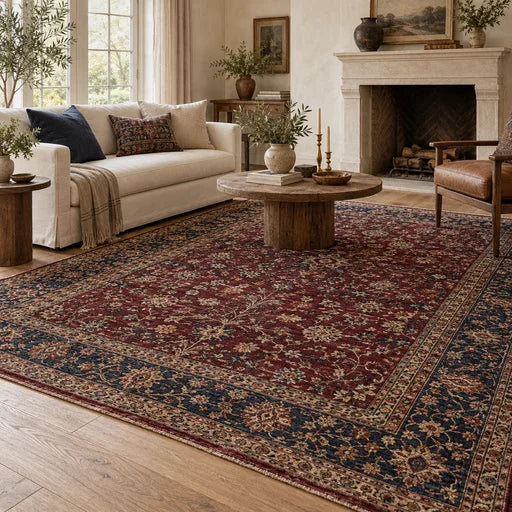
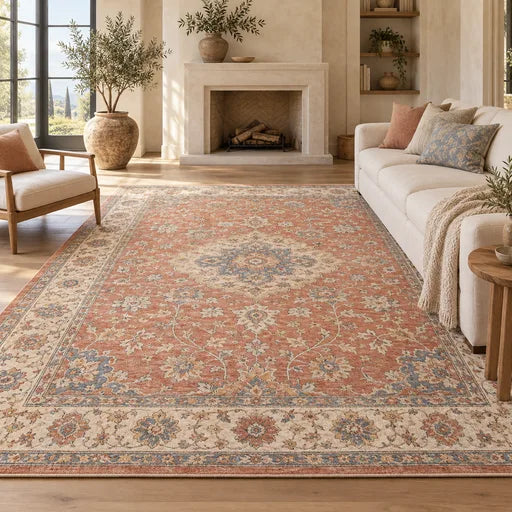
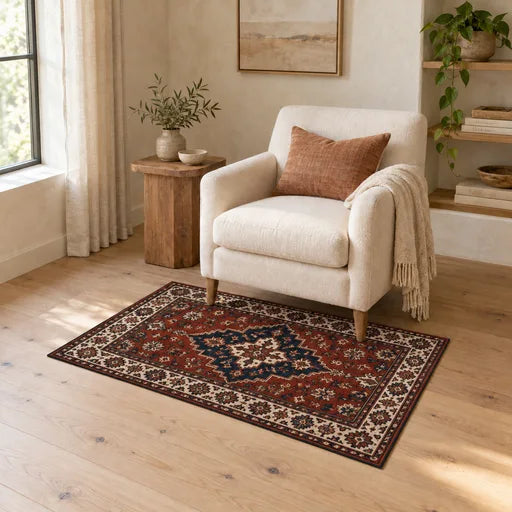
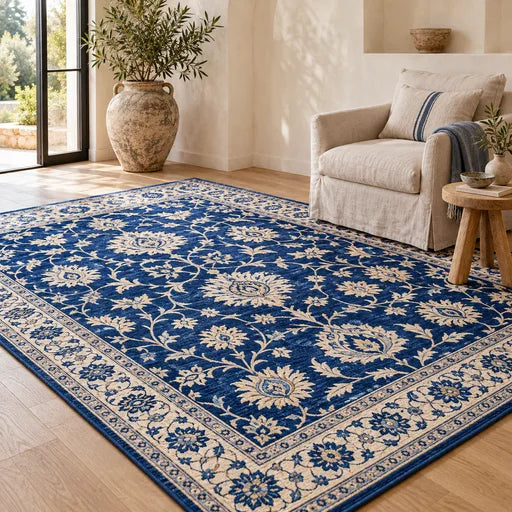
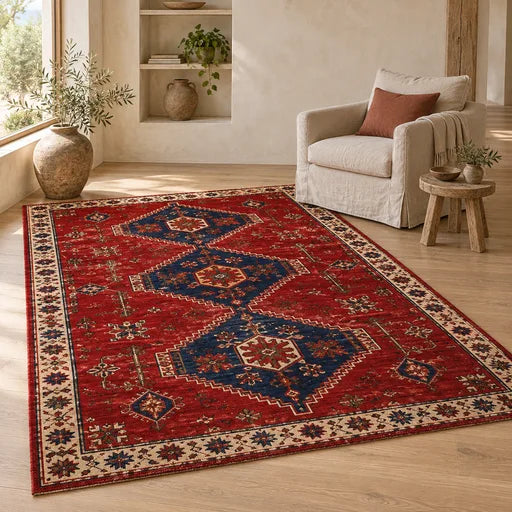
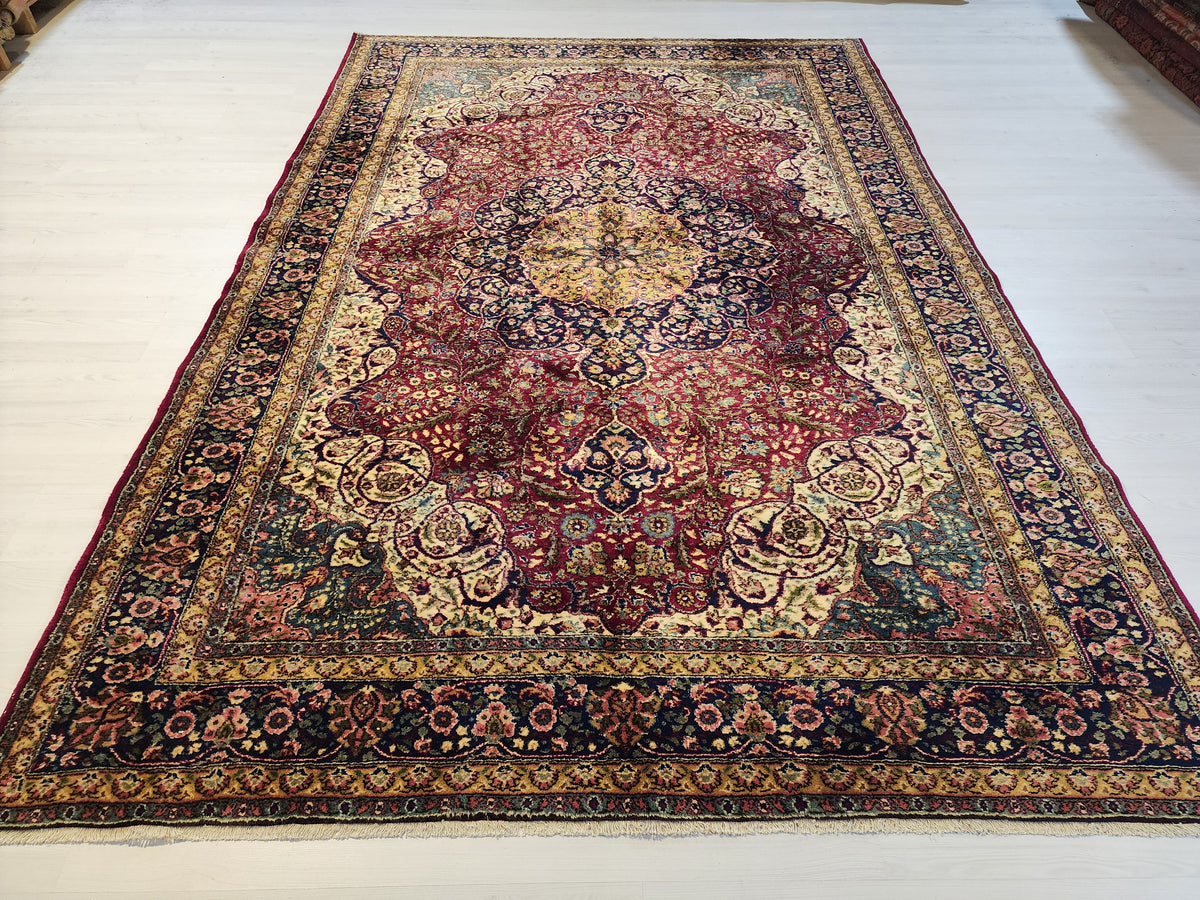
For a table seating six to eight people, a piece around 7 x 10 ft (213 x 305 cm) is the sweet spot. One example is this vintage Ladik medallion rug in red, blue and beige, and for a flatweave option there is this antique Göçmen kilim in red, purple and green. Every piece is one of a kind, so if you like a size, it will not come round again. Shipping is free worldwide, import duties are pre-paid for the US, UK, EU and Canada, and you have 14 days to return it.
Pieces from our collection
Every piece below is one of a kind and in stock today:
- Andronike — Vintage Ladik Medallion Rug, 7x10
- Sipylena — Antique Göçmen Kilim Rug, 7x10
- Theophano — Vintage Kayseri Medallion Rug, 6x10
- Magnesia — Vintage Karaova Rug, 6x10
Frequently asked questions
Can a dining table rug be too big?
Only if it climbs the walls or leaves less than about 8 inches (20 cm) of floor visible around the edge. A larger rug is fine as long as the chairs stay on it when pulled out, and a generous size usually looks more deliberate than a small one.
Is a round rug good under a round dining table?
Yes, a round or square rug under a round table works well. Choose a diameter at least 4 feet (122 cm) wider than the table so the chairs stay on the rug when pushed back. A square rug is a good choice if the room itself is square.
Should the front legs of the chairs be on the rug?
All four legs should stay on the rug, both when the chair is tucked in and when it is pulled out. If only the front legs sit on the rug, the chair tilts as people sit down, which is uncomfortable and wears the edge of the rug.
Is a kilim or a pile rug better under a dining table?
For daily meals, a flatweave kilim or a low-pile wool rug is easiest. Chairs slide smoothly and crumbs are simple to vacuum. Deep or shaggy piles trap food and make chairs wobble, so we would avoid them in a dining room.
Written by the team at Heritage Nomadic Art Gallery in Sultanahmet, Istanbul, the gallery behind TurkishRug.com, where every rug and pillow is chosen, washed and photographed by hand. Last updated October 21, 2026.