Hand-Knotted vs Hand-Tufted vs Machine-Made: A Weaver's Honest Comparison
Walk through any furniture store and you will see rugs labeled "handmade." The word covers three completely different things — and the difference between them is the difference between a rug that lasts a century and a rug that lasts five years.
We sell only one of the three types: hand-knotted. This is not snobbery; it is a craft decision. But our customers regularly ask us about the other two, and the honest comparison is worth knowing whether you buy from us or anyone else.
The three types in one sentence each
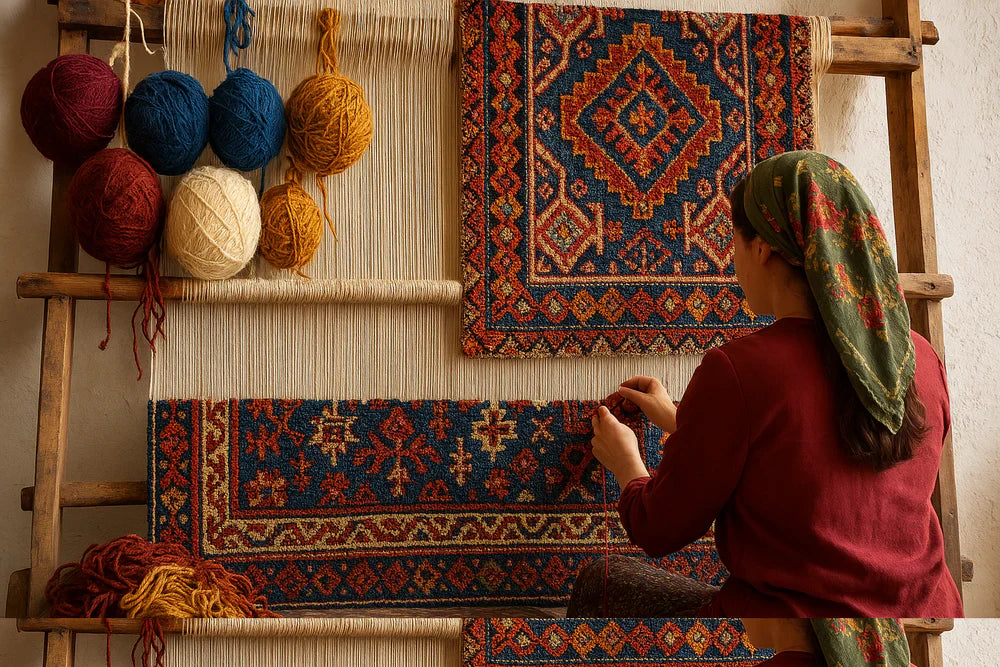
- Hand-knotted: One weaver, one knot at a time, on a vertical or horizontal loom. Months or years of work per rug. Lifespan: 50-200 years.
- Hand-tufted: One person, one tufting gun, punching yarn through a backing cloth. Hours or days of work per rug. Lifespan: 5-15 years.
- Machine-made: A large industrial loom following a programmed pattern. Minutes per rug. Lifespan: 3-10 years.
All three can be called "real rugs." None of them are scams as long as they are honestly labeled. The problem is that they are often not honestly labeled, and the price differences are vast.
Hand-knotted in detail
How it is made
A weaver sits at a loom on which vertical warp threads have been stretched tight. She (it is almost always a she, in Anatolian tradition) ties one small piece of colored yarn around two warp threads at a time, knot by knot. Between rows of knots, she weaves horizontal weft threads to lock the knots in place. After every few rows, she beats the weft down with a heavy comb to compress the structure.
A skilled weaver makes 5,000 to 12,000 knots per day depending on knot density. A modest 5×7 rug contains 600,000 to 800,000 knots. The math: 2 to 6 months of daily work per rug.
How to recognize it
- The back: pattern is visible on the back, individual knots are visible as small dots of color
- The fringe: an extension of the rug's own warp threads, cannot be removed without destroying the rug
- Slight irregularities: the pattern is not mathematically perfect; small variations show the hand that made it
- Weight: a hand-knotted wool 5×7 typically weighs 18-30 lbs
What you pay for
The labor. Mostly the labor. A hand-knotted wool rug at $50 is impossible — the wool alone costs more. Real hand-knotted rugs run from a few hundred dollars (smaller, village-quality vintage pieces) into tens of thousands (large, fine workshop antiques).
The pieces in our hand-knotted rug collection are all genuinely hand-knotted. We can confirm by sourcing — we know which villages and workshops we buy from.
Lifespan
A well-cared-for hand-knotted wool rug lasts 50-200 years. There are antique Anatolian and Persian pieces in museum collections that are 400+ years old and still recognizable. With reasonable care (vacuum, rotate, professional clean every few years), a hand-knotted rug outlasts the room it was bought for.
Hand-tufted in detail
How it is made
A tufter stands at a vertical canvas backing (the same kind used for embroidery on a larger scale). They use a pneumatic tufting gun — a hand-held tool that punches yarn through the backing in U-shapes. The gun pushes a loop of yarn through the canvas, then cuts the loop. The tufter moves the gun in patterns to fill in the design.
After the front is tufted, the back is coated with latex glue to hold all those loose tufts in place. Then a final cloth scrim is glued over the back to hide the glue and the loose ends.
A tufted rug takes hours to a few days to make, depending on size and complexity. There is genuine skill involved — the tufter needs steady hands and pattern judgment — but it is closer to skilled embroidery than to traditional weaving.
How to recognize it
- The back: covered with a fabric scrim, often white or beige cloth. You cannot see knots through it.
- The feel: the back is stiff because of the latex glue layer
- The fringe: sewn on separately, often visibly stitched. You can pull it off without destroying the rug.
- The smell: new hand-tufted rugs smell of latex glue for weeks or months
- Weight: similar to hand-knotted, sometimes lighter
What you pay for
Less than hand-knotted, more than machine-made. Typical price range: $200-2,000 for a 5×7 hand-tufted wool rug. The plush look of a hand-tufted rug can closely mimic the look of a hand-knotted piece at a fraction of the cost.
Lifespan and problems
This is where hand-tufted rugs fall short. The latex glue that holds the entire rug together does not age well:
- After 5-10 years, the glue starts to dry out and crack
- The backing scrim begins to flake and shed (the white residue some owners notice on their floor)
- Tufts come loose as the glue fails — the rug starts "shedding" or developing bald patches
- Professional cleaning can accelerate the glue's failure (water plus heat plus the cleaning solvents)
By year 15, most hand-tufted rugs are decorative writeoffs. They do not have antique potential. They are not collectible. They were made to look beautiful for a decade.
Machine-made in detail
How it is made
An industrial weaving loom — large, automated, computer-controlled — runs continuously, weaving rugs at high speed. The loom uses pre-spun yarn (often synthetic, sometimes wool blends) fed from large spools. A computer follows a pattern file and instructs the loom which color of yarn to insert where.
Modern machine-made rugs are extraordinarily good at imitating hand-knotted designs visually. The patterns are faithful copies of traditional Persian, Turkish, or Caucasian designs. From the front, on a dim floor, a $200 machine-made Belgian-loomed rug can look surprisingly similar to a $2,000 hand-knotted piece.
How to recognize it
- The back: shows a grid-like weaving pattern, no individual knots
- The edges: sewn or glued binding, sometimes with a visible stitched border
- The fringe: sewn or glued on, comes off easily
- The fiber: often polypropylene or other synthetic; rarely natural wool in budget machine-made; the fiber feels slick, slightly plasticy
- The pattern: mathematically perfect, every repeat identical, no irregularities
What you pay for
The cheapest of the three. A machine-made 5×7 "Turkish style" rug costs $40-300 typically. The pricing covers materials, factory operation, transport, retailer margin. Almost no labor cost in the per-unit equation.
Lifespan
Synthetic-fiber machine-made rugs flatten and lose their pile within 3-7 years of moderate use. The fibers are designed for short-term retail appeal, not longevity. They do not develop patina; they degrade.
Wool machine-made rugs (rare in the budget tier, more common in mid-market home furnishings) can last 10-15 years but still cannot be repaired or restored in any meaningful way.
Side-by-side comparison
| Feature | Hand-knotted | Hand-tufted | Machine-made |
|---|---|---|---|
| Labor time | 2-12 months | 1-3 days | 15 min - 2 hours |
| Back appearance | Knots visible | Cloth scrim | Woven grid |
| Fringe | Integral (warp threads) | Sewn on | Sewn or glued on |
| Wool common? | Almost always | Sometimes | Rarely |
| Repairable? | Yes — knot by knot | No | No |
| Lifespan | 50-200 years | 5-15 years | 3-10 years |
| Resale value | Holds or appreciates | Near zero | Zero |
| Typical price 5×7 | $400-5,000+ | $200-2,000 | $40-300 |
Why this matters
Three reasons we think the distinction is worth knowing:
Total cost over time
A $200 machine-made rug replaced every 5 years over 40 years = $1,600 (and that's before inflation). A $1,200 hand-knotted vintage wool rug bought once still looks beautiful at year 40. The "expensive" option is often the cheaper one over time.
Environmental
Synthetic machine-made rugs are plastic — polypropylene, polyester, nylon. They cannot be recycled meaningfully and they sit in landfills for centuries. A hand-knotted wool rug is a biological object made from animal fiber and plant dyes; if it ever finally dies, it composts.
Aesthetic
Hand-knotted wool rugs develop character with age — softening, patinating, becoming more themselves. Machine-made and hand-tufted rugs do the opposite: they degrade, lose their pile, start to look worn out without ever looking better.
When hand-tufted or machine-made make sense
We are not against the other two construction types — they have their place:
- Hand-tufted: rental apartments, child's playroom, anywhere you need a soft, decorative rug but do not want to invest in an heirloom. Just know what you are buying.
- Machine-made: temporary spaces, high-spill areas (kitchen near the dishwasher), or as the cheap floor cover under a smaller hand-knotted statement piece (see our layering guide).
The problem is not that these rugs exist — it is that they are sometimes sold as "handmade Persian-style rugs" at prices that imply hand-knotted construction, taking advantage of buyers who do not know the difference.
The honest test
Two minutes, one question, definitive answer: "Can you show me a clear photo of the back of the rug?"
If you see individual knots, it is hand-knotted. If you see a cloth scrim, it is hand-tufted. If you see a woven grid pattern, it is machine-made. Every reputable seller will send this photo within hours. Anyone who refuses or makes excuses is hiding the construction.
What we sell
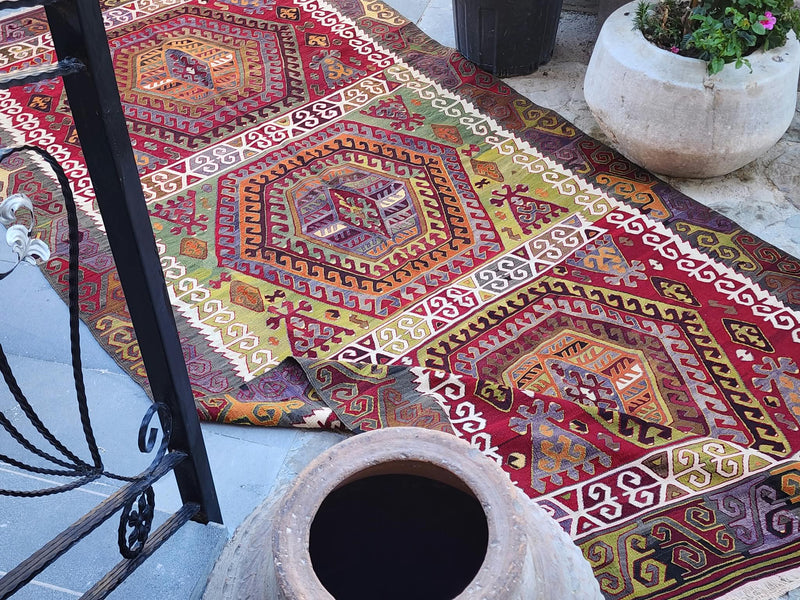
Only hand-knotted. Every piece in every collection — Turkish rugs, Vintage rugs, Antique rugs, Kilims — is genuinely hand-knotted (or, for the kilims, hand-woven on a traditional loom without knots, which is a separate but equally traditional craft).
Not because the other types are bad, but because they are not what we know. We grew up around looms in Anatolia. The pieces we sell are the kind we would have in our own homes — and ours are hand-knotted.
Final word
"Handmade rug" is one of those phrases the marketing industry has worn down to mean almost nothing. Hand-knotted is the real version of the craft, the one with centuries of tradition behind it. Hand-tufted is a faster, modern method that imitates the look. Machine-made is industrial production. None of them are evil; all of them have their place; but the price difference between them is enormous, and the lifespan difference is even bigger.
Know which one you are buying. The rest takes care of itself.