How to Identify an Authentic Hand-Knotted Turkish Rug
The internet has made it easier than ever to buy a "Turkish rug." It has also made it easier than ever to be fooled. Most rugs sold under that label are not what people think they are — they are machine-made, printed, or hand-tufted, and they have nothing to do with the centuries-old hand-knotting tradition of Anatolia.
You do not need to be an expert to spot the difference. You just need to know what to look for. Here is the checklist we walk through every time we evaluate a rug.
1. Turn it over
This is the single most reliable test. The back of a real hand-knotted rug looks almost identical to the front. You should be able to see the design clearly on the back, with individual knots visible as small dots of colour, slightly irregular, packed tightly.
What machine-made and tufted rugs look like from the back:
- Machine-made: a fabric backing covers the rear. You see no knots, only a grid pattern or a backing material like jute or polyester.
- Hand-tufted: the back is covered with a glued cloth scrim. The rug feels stiff because of the glue.
- Printed: the rug is a single piece of fabric with the pattern printed on top. The back is blank or shows the reverse printing faintly.
A real hand-knotted rug shows the design from both sides. No exceptions. If the back is hidden, the rug is hiding something.
2. Look at the knots up close
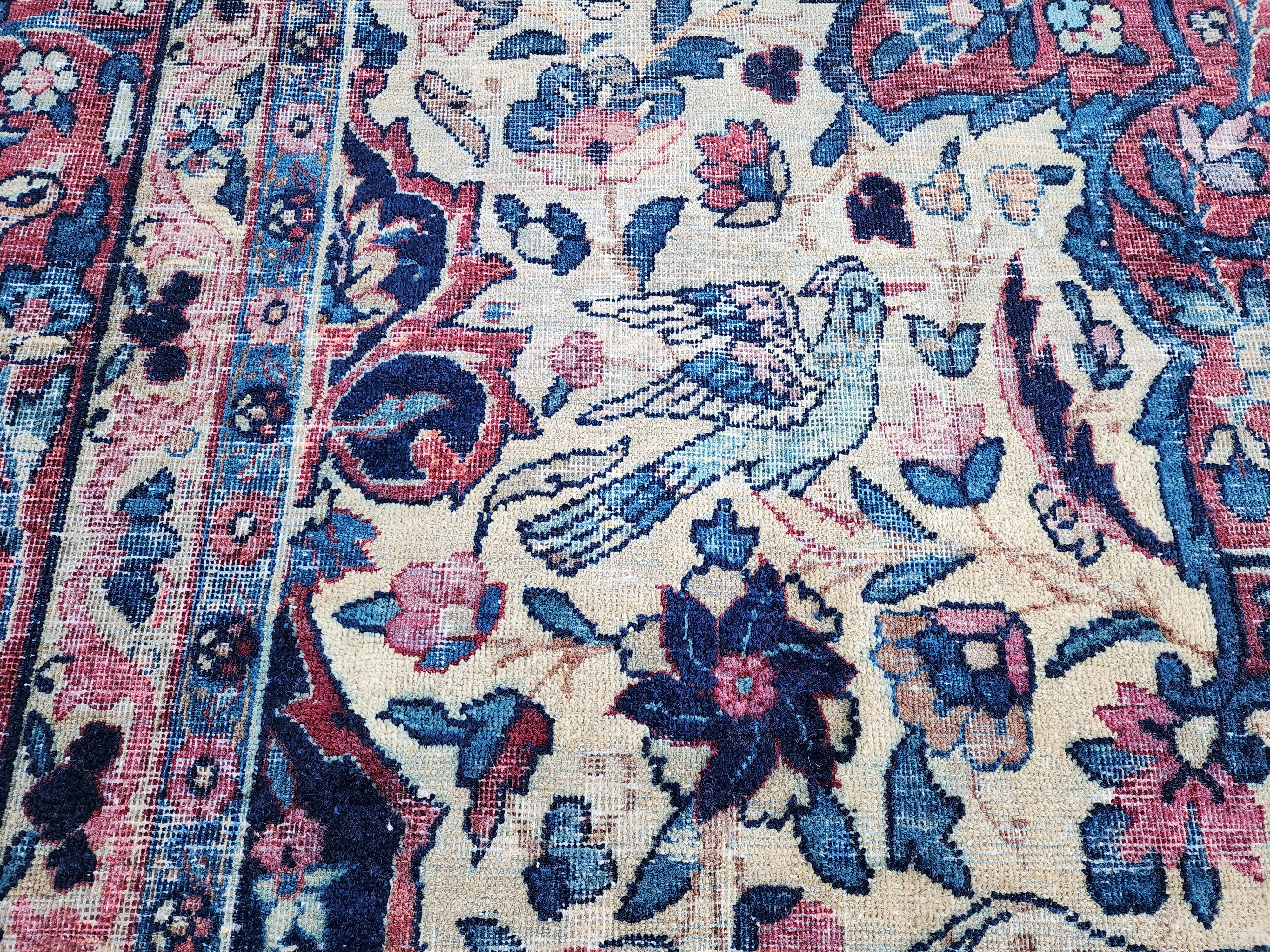
If you bend back a corner and look at the pile, you should see individual knots — small bundles of yarn tied around two warp threads (in Turkish/symmetric knotting) or one (in Oriental/asymmetric knotting). The knots should be:
- Slightly irregular in size (a human tied them)
- Tightly packed
- Each one visible as a discrete unit
Machine-made rugs show no knots at all — the pile is woven through a different mechanism. Tufted rugs show U-shaped tufts glued from behind, not knots.
3. Check the fringe
The fringe of a real hand-knotted rug is part of the rug. The warp threads run the length of the rug, and at each end they emerge as the fringe. You cannot pull the fringe off without destroying the rug itself.
On machine-made rugs, the fringe is often sewn on after. You can sometimes see a seam where the fringe attaches. Try gently lifting the fringe at one end — if it lifts as a separate piece, the rug is not hand-knotted.
4. Feel the wool
Hand-spun natural wool has a particular feel. It is slightly uneven, sometimes with tiny vegetable fragments still visible, soft but with body. The pile feels alive — springy when you press it, settling back when released.
Synthetic fibre feels different. It is too uniform, too slick, sometimes squeaky between thumb and forefinger. If you rub two areas of the rug together, synthetic fibre often makes a quiet plastic sound. Real wool stays silent.
The smell is also distinct. Hand-knotted wool rugs have a faint, neutral wool smell — like a clean sheep. Synthetic rugs sometimes smell of chemicals (especially when new) or have no smell at all.
5. Look for irregularities
This sounds counterintuitive, but in a real hand-knotted rug, perfection is a red flag. A human weaver produces tiny inconsistencies:
- Slight variations in pattern width along the rug's length
- Minor colour shifts within a single field (the abrash we mentioned)
- Borders that do not perfectly mirror each other corner to corner
- Knot density that varies slightly across the rug
If a rug looks too perfect — every line measured, every corner identical, every colour absolutely uniform — it is probably machine-made. Real weaving has the signature of the hand that made it.
6. Check the colours and dye behaviour
Natural dyes have a particular look. The reds are slightly varied across the rug (not flat). Indigo blues fade gracefully and unevenly. Yellows go from bright when new to soft gold over decades.
Synthetic dyes look flat and fade poorly. If a rug claims to be antique but the colours are blinding-bright with no variation, the dyes are not original.
A simple test: lift the pile and look at the colour at the base versus the tip. On natural dye, the base is usually slightly more saturated (it has not been exposed to light). On synthetic dye, base and tip often look identical because the dye does not interact with light the same way.
7. The weight
A hand-knotted wool rug is heavy. A 5'×7' wool-on-cotton hand-knotted rug typically weighs 18-30 lbs. The same size machine-made rug or polyester print weighs 8-15 lbs.
If you can lift a rug easily with one hand and it is "Turkish wool," it is probably not.
8. Look at the selvedge (edge binding)
The long edges of a hand-knotted rug are bound by an over-stitching of wool yarn, integrated with the foundation. These edges are slightly irregular and can be a different colour from the main field.
Machine-made rugs have a uniform sewn or glued edge. The transition from field to edge is too clean.
9. Ask where it was made
A real hand-knotted Turkish rug was woven in Turkey, by a specific weaver in a specific village or workshop. A seller should be able to tell you the region — Konya, Kayseri, Anatolia generally, Oushak, etc. If the answer is vague ("Turkish-style," "Oriental design"), the rug is likely not from Turkey.
For every rug in our gallery, we know the source region. We have visited most of the villages we buy from. This is not the case for the typical online "Turkish rug" listing.
10. Be careful with "hand-tufted"
"Hand-tufted" sounds similar to "hand-knotted" but is a completely different thing. Hand-tufted rugs are made by punching yarn through a backing fabric with a hand-held tufting gun. The result is a fluffy pile rug that takes a few hours to make instead of weeks.
Hand-tufted rugs have a fabric backing glued on. They do not last like hand-knotted rugs (the glue degrades, the tufts come loose), and they are not collectible. The label "hand-tufted" is technically true but it is not what people picture when they think of a Turkish or Oriental rug.
What a real piece costs
Authentic hand-knotted Turkish rugs take weeks to months of full-time work to make. A weaver might produce 10-30 cm of finished rug per day depending on the knot density. So:
- A 5×7 hand-knotted wool rug represents 2-6 months of one weaver's labour
- A 9×12 fine Kayseri can be 1-2 years
- A Hereke silk rug at high knot count can be 3-5 years
This is the real cost floor. If a "hand-knotted Turkish rug" is offered at $50, it is not what the label claims.
One quick visual test
If you only have time for one check, do this: bend back a corner of the rug and look at the back of the pile at the bend. Real hand-knotted rugs show the knots clearly at the bend. Machine-made rugs show fabric backing or a smooth woven structure. This single test will save you from 95% of mistakes.
Final word
The hand-knotted rug tradition in Turkey is centuries old. Every authentic piece carries that history — in the wool, in the dyes, in the patterns, in the literal hand of the weaver. Knowing what to look for is how you separate the real thing from a print.
Every rug in our Turkish rugs collection is hand-knotted, sourced directly from Anatolian weavers and workshops. If you ever have doubts about a specific piece, message us — we will tell you exactly what it is, how we got it, and what makes it the real thing.