








Article: What Size Is a Kitchen Runner Rug? Width, Length and Placement
What Size Is a Kitchen Runner Rug? Width, Length and Placement
Quick answer: A kitchen runner rug is usually 2 to 3 feet (61–91 cm) wide and 5 to 10 feet (152–305 cm) long. Choose a width that leaves 4–6 inches (10–15 cm) of bare floor each side, and a length that leaves 6–12 inches (15–30 cm) clear at each end of the counter run.
What Size Is a Kitchen Runner Rug?
Most kitchen runners are between 2 and 3 feet (61–91 cm) wide and between 5 and 10 feet (152–305 cm) long. The right choice depends on your kitchen, not on a standard: the width of the walkway and the length of the counter decide it.
A runner is really a rug for one job, which is to cushion and protect the spot where you stand and walk most. In a galley or single-wall kitchen, that is the strip in front of the sink, hob and worktop.
| Runner size | In centimetres | Best for |
|---|---|---|
| 2 x 5 ft | 61 x 152 cm | Short counter run, one sink or hob |
| 2 x 6 ft | 61 x 183 cm | Small galley kitchen |
| 2.5 x 8 ft | 76 x 244 cm | Medium counter run |
| 3 x 10 ft | 91 x 305 cm | Long galley or open-plan kitchen |
How Long Should a Kitchen Runner Be?
Measure the length of the floor you want to cover, usually from one end of the worktop to the other, then take off 12–24 inches (30–60 cm) so that 6–12 inches (15–30 cm) of bare floor shows at each end. A runner that fills the whole length looks cramped, and one that is too short looks lost.
- Measure the floor length of the counter run in inches or centimetres.
- Subtract 12–24 inches (30–60 cm) for the bare floor at the ends.
- Round down to the nearest size available.
For example, a counter run of 9 feet (274 cm) suits a runner of 7 to 8 feet (213–244 cm). A 6 ft (183 cm) run suits a 4 to 5 ft (122–152 cm) runner.
How Wide Should a Kitchen Runner Be?
Leave 4–6 inches (10–15 cm) of bare floor on each side. Most galley kitchens have an aisle of 3.5 to 4 feet (107–122 cm), so a runner of 2 feet (61 cm) or 2.5 feet (76 cm) usually fits well. In a very narrow aisle, a 2 ft (61 cm) runner is safer, as a wider one will curl against the cabinet plinth.
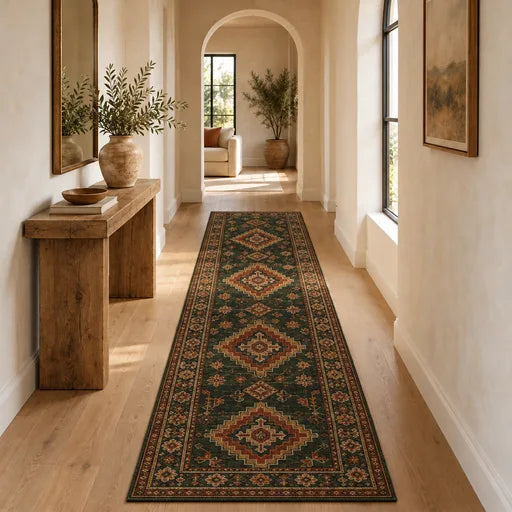
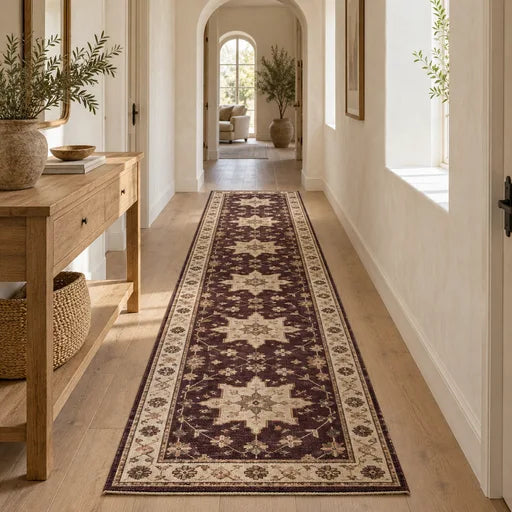
If you are also choosing a runner for a corridor, the rules are similar, and we cover them in our guide to choosing a runner rug for a narrow hallway.
Do Vintage Kitchen Runners Stand Up to Daily Use?
Well-made wool is tough, which is why hand-woven Anatolian pieces have lasted for decades on village floors. A few points to keep in mind in a kitchen:
- Choose flatweave or short pile. A kilim is thin, lies flat against the floor and is easy to shake out. Browse our kilim and flatwoven rugs.
- Choose a busy pattern. Stripes, diamonds and tribal motifs hide small marks. Our striped rugs and geometric rugs are good places to look.
- Use a thin rug pad. A non-slip pad of about 1/8 inch (3 mm) keeps the runner in place on tile or hardwood and is much safer when the floor is wet.
- Expect some wear. Wool is durable, but grease and water are not good for any rug, so keep the runner away from the cooker splash zone where possible.
How Do You Care for a Rug in the Kitchen?
Shake it out or vacuum it once a week, with the rotating brush off. Blot spills straight away with a dry cloth, then a damp one, and let the rug dry fully before putting it back on the floor. Turn it round every few months so that the area in front of the sink does not wear faster than the rest. You will find more detail in our vintage wool rug care guide.
We do not suggest machine washing a hand-woven runner. Wool can felt and dyes may bleed, so a gentle hand-clean or a specialist rug cleaner is the safer route.
How Do You Measure Your Kitchen for a Runner?
Use a tape measure and write the numbers down before you shop. You need three: the length of the counter run, the width of the aisle between the cabinets, and the clearance under any door that opens over the floor, such as a dishwasher, oven or back door. Then mark the planned runner on the floor with masking tape and walk on it for a day. If you trip over the tape, or the oven door catches it, adjust the size before you buy.
Where Should the Runner Go in the Kitchen?
Galley kitchen
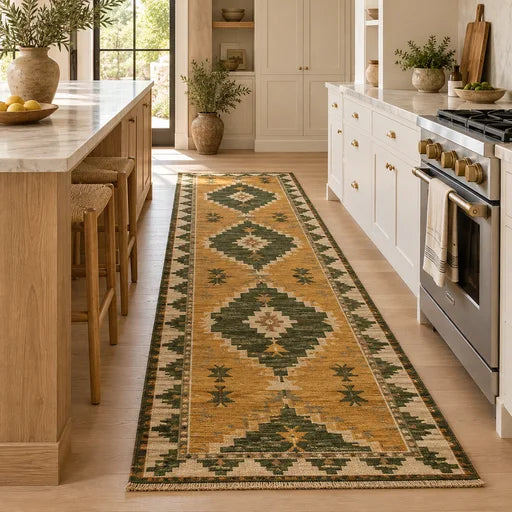
Centre the runner along the aisle, in front of the sink and hob. Keep it clear of the dishwasher door, which needs room to open fully.
Island kitchen
Use one runner in front of the sink and a second, matching or complementary, in front of the island if the walkway is long. Two shorter runners are often more practical than one very long one.
Open-plan kitchen
Use a longer runner to link the working area to the dining space. Our kitchen rugs and runner rugs collections show sizes from short to extra long.
Some Runners That Suit a Kitchen
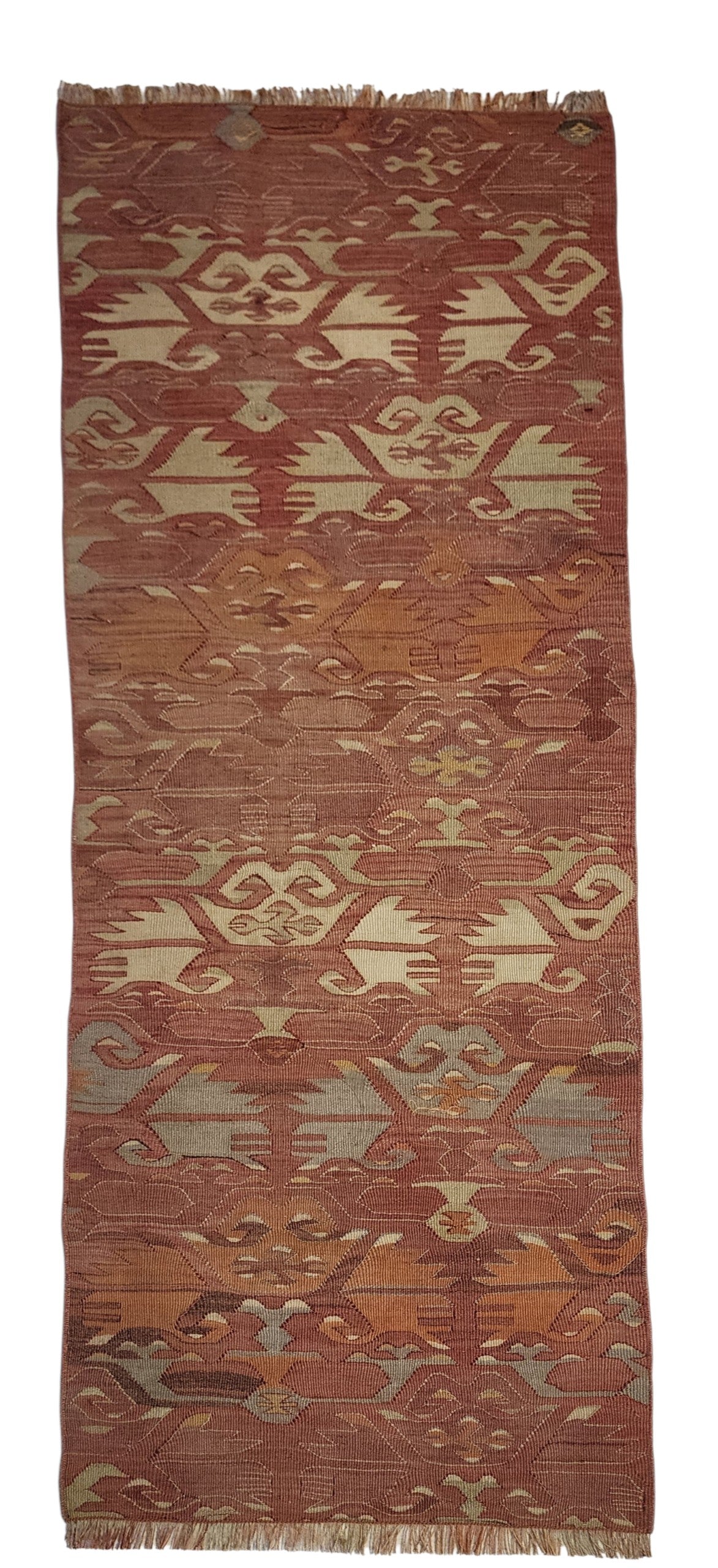
For a small galley, this vintage Afyon kilim runner in pink and orange, 2 x 5 ft is a good fit. For a longer counter run, look at this brown and orange kilim runner, 8 x 2 ft. Each piece is one of a kind, with free worldwide shipping, pre-paid duties for US, UK, EU and Canada, and 14-day returns. For help with room sizes in general, see how to choose the right rug size for every room.
Pieces from our collection
Every piece below is one of a kind and in stock today:
- Eudokia — Vintage Afyon Kilim Runner, 2x5
- Polyhymnia — Handwoven Turkish Kilim Runner: Boho Tribal Rug, 8'9" x 2'9"
- Turhan — Vintage Konya Wool Runner Rug
- Pinikir — Vintage Afghan Wool Runner Rug
Frequently asked questions
Should a kitchen runner go in front of the sink?
Yes, in most kitchens the best place is in front of the sink and worktop, where you stand longest. Make sure the runner sits flat and clears the dishwasher and oven doors. A thin non-slip pad underneath keeps it from shifting when you turn.
Can I use a 2 x 3 ft rug in the kitchen?
A 2 x 3 ft (61 x 91 cm) rug works as a mat in front of a sink or hob, not as a runner. For a counter run longer than about 4 feet (122 cm), choose a true runner of 5 feet (152 cm) or more.
Is a kilim good for a kitchen floor?
Yes. A flatweave kilim lies flat, has no pile to trap crumbs and is simple to shake out. Pick wool in a patterned design and keep it away from the cooker's splash zone to reduce grease marks.
How much floor should show around a kitchen runner?
Aim for 4–6 inches (10–15 cm) of bare floor along each side and 6–12 inches (15–30 cm) at each end. This framing makes the runner look intentional and stops the edges from curling against cabinets.
Written by the team at Heritage Nomadic Art Gallery in Sultanahmet, Istanbul, the gallery behind TurkishRug.com, where every rug and pillow is chosen, washed and photographed by hand. Last updated October 21, 2026.