Turkish Rug Knot Explained: How the Ghiordes Knot Works
Quick answer: The Turkish rug knot, also called the Ghiordes or symmetrical knot, loops a short length of wool around two neighbouring warp threads, with both ends coming up between them. It makes a strong, even knot used in most Anatolian pile rugs. You can see the knots as small bumps on the back of the rug.
What Is the Turkish Rug Knot?
The Turkish knot, also called the Ghiordes knot or the symmetrical knot, is the knot used in most pile rugs woven in Anatolia. The weaver takes a short length of wool yarn, loops it around two neighbouring warp threads, and pulls both ends up to the surface between them. Each knot is a small closed loop at the back and a pair of tufts at the front.
Thousands of these knots, packed row after row and trimmed level, make the pile you walk on. The knot is the basic unit of a hand-knotted rug, and how many there are per square inch is one of the main things that separates a coarse village rug from a fine one.
Ghiordes is the old name of the town now called Gördes in western Turkey, which is why the name stuck. The same knot is used well beyond Turkey, in the Caucasus and in parts of Central Asia, so the name describes a technique rather than a guarantee of origin.
How Is a Turkish Knot Tied?
Every rug starts with a loom strung with warp threads, the long vertical threads that run the full length of the rug. The knots are tied across them, one at a time, along a horizontal row. Here is the sequence, step by step:
- The weaver picks up the coloured wool for that spot in the pattern and passes it in front of two adjacent warp threads.
- Both ends of the wool come back through the gap between the two warps, so the yarn wraps fully around each of them.
- The weaver pulls the ends down, which tightens the loop, then cuts the yarn with a small knife, leaving two tufts on the surface.
- When a full row of knots is complete, one or more weft threads are passed across the loom and beaten down hard with a heavy comb to lock the row in place.
- After several rows, the pile is trimmed level with shears, and the pattern slowly appears.
Because the yarn wraps both warps equally, the knot is symmetrical. The two tufts sit side by side, centred between the warp pair, and the knot is very secure: it holds firmly even when the rug has been walked on for decades.
What Is the Difference Between a Turkish Knot and an Oriental Knot?
Many people ask about the other common knot. It is called the Senneh knot or asymmetrical knot, and it is found in rugs woven in parts of the Middle East, India, Pakistan and China, as well as in some Turkish workshops. In this knot, the yarn wraps around one warp thread and only passes behind the neighbouring one. The tufts then emerge side by side in a different position.
The two knots differ in how they feel and how fine a pattern they can draw:
| Feature | Turkish (symmetrical) knot | Senneh (asymmetrical) knot |
|---|---|---|
| Wraps around | Two warp threads | One warp thread, passes behind the other |
| Shape of tufts | Even pair, centred | Slightly offset pair |
| Typical density | Coarser, bolder designs | Allows finer, curved detail |
| Strength | Very firm and secure | Firm, can be tied tighter |
| Typical look | Geometric, angular lines | Rounded, flowing lines |
The asymmetrical knot lets weavers pack more knots per inch, which suits curving floral patterns. The Turkish knot gives sturdy, slightly more angular lines, which is why so many Anatolian rugs carry bold medallions, borders and geometric motifs. Neither knot is better. They are different tools, and the best rug in either family is one that is well woven.
The knot also does not tell you a rug's quality on its own. Wool quality, dye, evenness of the weave and condition all matter. For a wider look, read our guide on whether Turkish rugs are good quality.
How Can You Check the Knot on a Rug Yourself?
You do not need special equipment. Turn the rug over and look at the back, where the knots show clearly as small bumps or dots in the colours of the front. Here is what to look for:
- Bumps at the back that match the front pattern. In a hand-knotted rug, the design is visible, slightly blurred, on the back. This is a good first sign.
- Irregular rows. Slight waviness and small changes in knot size are signs of a person at the loom, not a machine.
- Part the pile. Bend the rug back on itself so the pile opens along a line. You will see the base of the tufts and the warp threads they wrap around. In a symmetrical knot, you see the two tufts of each knot sharing the same pair of warps.
- Fringe that is part of the rug. On a hand-knotted rug the fringe is the loom warp continuing into the body of the rug. It is not sewn on afterwards.
Telling the Turkish from the asymmetrical knot by eye takes practice, especially in finer rugs. If you are unsure, look at the overall picture rather than a single knot: the back, the fringe and the pile height should all tell the same story. Our guide to identifying an authentic hand-knotted Turkish rug walks through this in more detail.
How Many Knots Does a Turkish Rug Have?
Knot density is usually given as knots per square inch (KPSI) or per square decimetre. For a quick guide:
| Description | Rough knots per square inch | What to expect |
|---|---|---|
| Coarse village weave | Under 40 | Thick pile, bold simple design |
| Medium weave | 40 to 100 | Most vintage Anatolian rugs, good detail |
| Fine weave | Above 100 | Delicate design, flatter pile |
These bands are only a rough guide, and different dealers draw the lines in slightly different places. To count yourself, measure one inch along the back of the rug with a ruler, count the knots across, then count the knots down one inch and multiply the two numbers.
A higher count is not always better. A coarse, thick Konya rug has a different charm from a fine one, and its knots are tied with chunkier wool that wears well. For a hallway or a family room, a medium count is often the sweet spot: dense enough to hold a pattern, strong enough for daily use.
If you are comparing a knotted rug with a thick, tufted-looking one, our overview of hand-knotted, hand-tufted and machine-made rugs explains how the back of each looks.
Do Kilims Have Knots?
No. A kilim is a flatweave. The coloured wefts are woven over and under the warp threads, so there is no pile and no knot. This is why a kilim is thinner, lighter and the same on both sides. If you are choosing between the two, our explainer on pile versus flatweave covers the difference. Browse our kilim and flatwoven rugs if you prefer a flat finish.
Some rugs combine both techniques, with areas of flatweave and areas of knotted pile, but these are less common. Most pieces you will see are one or the other.
Why Does the Knot Matter When You Buy a Vintage Rug?
For a buyer, the knot is mostly a way to confirm that a rug is what it is described to be. A hand-knotted rug will always cost more than a tufted or machine-made rug, because each knot is tied by a person. Knowing what to check protects you.
Here is how we suggest using this knowledge when shopping:
- Always ask for a photo of the back of the rug. A seller who cannot supply one is a warning sign.
- Check that the design on the back is clear and the rows are slightly uneven.
- Look at the sides (the selvedge) and the ends. They should be woven into the rug, not glued or sewn on.
- Compare knot density to the price and the size, not just to the look.
- Remember that wear is normal on a vintage rug. Low pile in spots does not mean the knots have failed, but loose knots with visible warp threads can need repair.
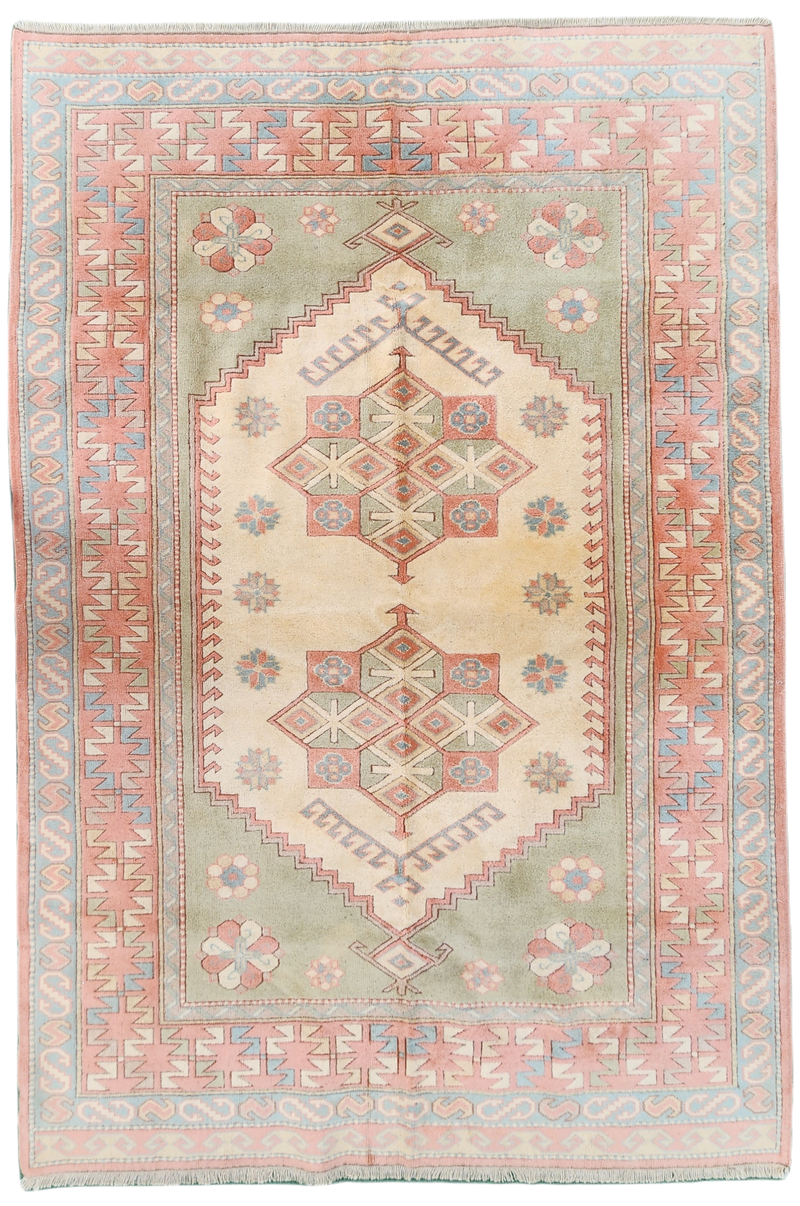
Every piece in our hand-knotted rugs collection is vintage or antique, hand-made in Anatolia, and one of a kind. A small example is Dione, a vintage Konya rug at about 2x3 ft (60x90 cm), which is a good size to examine the weave up close. Free worldwide shipping, pre-paid import duties for the US, UK, EU and Canada, and 14-day returns apply to every order. You can also see the broader range in our Turkish rugs collection.
How Do You Care for a Rug With Turkish Knots?
The symmetrical knot is secure, so daily care is simple. Vacuum without a beater bar, turn the rug every six months so wear is even, and keep the fringe out of the vacuum head. Avoid pulling on any loose tuft. Trim it level with scissors if it sticks out. For deeper cleaning, see our guide to caring for a vintage wool rug.
If you see a bald patch where knots have fallen out, a repair is possible by re-knotting. Our note on handmade rug repair explains what to expect.
The Short Version
The Turkish knot loops yarn around two warp threads, giving a strong, symmetrical, slightly angular result that suits Anatolian designs. You can check it from the back of the rug, where the pattern shows in small bumps and the rows are not perfectly straight. Higher knot counts allow finer drawing, but a medium-density rug is usually the best choice for everyday life. A kilim has no knots at all.
Pieces from our collection
Every piece below is one of a kind and in stock today:
- Dione — Vintage Konya Rug, 2x3
- Selçuka — Vintage Konya Rug, 2x4
- Glykeria — Vintage Anatolian Floral Rug, 5x7
Frequently asked questions
What is another name for the Turkish knot?
It is also known as the Ghiordes knot, after the old name of the western Turkish town now called Gördes, and as the symmetrical knot, because the yarn wraps evenly around two warp threads. All three names describe the same technique, which is found in many Anatolian pile rugs and in some rugs from other regions.
Is the Turkish knot better than the Senneh knot?
Neither is better. The Turkish knot is very secure and suits bold, geometric Anatolian designs. The Senneh, or asymmetrical, knot can be packed more tightly, which allows finer curves. Quality depends mainly on the wool, the dye, the evenness of the weave and the condition of the rug, rather than on which knot was used.
How can I see the knots in my rug?
Turn the rug over and look at the back, where the knots appear as small bumps in the colours of the pattern. You can also fold the rug back on itself to open the pile and see the base of the tufts. Slight irregularity in the rows is normal and a sign of handwork.
Do kilims have Turkish knots?
No. A kilim is a flatweave, so the coloured weft threads are woven over and under the warp and no knots are tied. This makes a kilim thinner and the same on both sides. Knots only exist in pile rugs, where tufts of wool are tied to the warp threads.
How do I count the knots per square inch?
Turn the rug over and measure one inch along a row on the back. Count the knots in that inch, then count how many rows fall within one inch going the other way, and multiply the two numbers. Doing it in two or three places on the rug gives a more reliable average.
Written by the team at Heritage Nomadic Art Gallery in Sultanahmet, Istanbul, the gallery behind TurkishRug.com, where every rug and pillow is chosen, washed and photographed by hand. Last updated October 31, 2026.