
Rug Pad for Carpet: Which Type, Thickness and Size to Buy
Quick answer: For a rug on carpet, use a thin, firm, grippy rug pad, ideally about 1/8 in (3 mm) or thinner and made of natural rubber mesh or a slim felt-and-rubber blend. Cut it about 1 in (2.5 cm) smaller than the rug on every side. The pad stops creeping, wrinkles and rippling and protects the rug's back from friction.
Putting a rug on top of wall-to-wall carpet is common, and it is also where rugs misbehave most: they creep, wrinkle and ripple. The right rug pad prevents that. Here is how we think about pads for carpet, with practical thicknesses, materials and what to avoid.
Do you need a rug pad on carpet?
Yes, in most cases. A rug lying directly on carpet moves each time someone walks across it, because pile slides against pile. Over time the rug shifts, bunches up in the middle and the corners curl, which is both untidy and a trip hazard. A pad grips the carpet below and the rug above, and it stops that slow creeping.
A pad also reduces friction on the back of the rug. Hand-made wool rugs are durable, but constant rubbing against a carpet below will wear the knots and foundation faster than a protected back.
What kind of rug pad is best for carpet?
Carpet needs a different pad to a hard floor. A thick, soft pad on top of carpet makes the rug feel bouncy and can bunch. Look for a thin, firm, grippy pad, usually made for carpet-on-carpet use. Common options:
| Pad type | Best for | Notes |
|---|---|---|
| Natural rubber mesh or waffle | Rug on low-pile carpet | Strong grip and thin; check that it is labelled safe for your flooring |
| Felt and rubber combination | Rug on hard floors, some carpets | Adds cushioning; keep to a slim profile on carpet |
| Rug gripper tape or corner grippers | Small rugs, kilims | Easy to fit; may leave adhesive marks if left for years |
| Felt only | Hard floors | Cushions but does not grip enough on carpet |
Thickness
On carpet we suggest a pad of about 1/8 in (3 mm) or thinner. On a hard floor 1/4 in (6 mm) is the usual choice for comfort. If you are unsure, go thinner on carpet, because the carpet already supplies the cushioning.
Materials to avoid
Be careful with cheap PVC or vinyl pads. They can react with some floor finishes and stain, and they can degrade over time into a sticky residue. Choose a pad that states what it is made of and which surfaces it is safe for.
How do you size a rug pad?
The pad should be slightly smaller than the rug, about 1 in (2.5 cm) shorter on every side, so the edges do not peek out and nobody trips on them. For a 5 x 8 ft (152 x 244 cm) rug, buy a pad of about 4 ft 10 in x 7 ft 10 in (147 x 239 cm) or cut a larger one to fit. Use sharp scissors or a utility knife and cut on a flat surface.
Are flat-woven kilims different from pile rugs on carpet?
Yes. A kilim is thin and light, so it slides and ripples more than a heavy pile rug. A grippy pad is nearly essential under a kilim on carpet. Pile rugs are heavier, which helps, but they still benefit from a pad. See our explanation of kilim and pile rugs for the construction difference.
How do you lay a rug on carpet step by step?
- Vacuum the carpet so the grip surface sits flat.
- Roll the pad out with the grip side facing the carpet. Trim it to size.
- Lay the rug on top, centred, with an even margin on each side.
- Press down across the rug and check that corners lie flat.
- Re-check after a week and re-smooth if anything has moved.
If a rug arrives folded or rolled, let it lie flat for a day or two first. It will settle more quickly and the creases will relax.
What problems does a pad solve, and which does it not?
A pad solves sliding, rippling and back wear. It does not fix a rug that has been folded for a long time, and it will not flatten a rug with a badly distorted shape. If a corner keeps curling, press it flat under a heavy book for a day or two, or ask a rug specialist about gentle blocking.
It also does not replace good underlay for a hard floor. If you move the rug to a bare floor later, buy a pad for that surface, because a thin carpet pad gives little cushioning on wood or tile.
Quick checklist before you buy
- Measure the rug and subtract about 2 in (5 cm) from each dimension.
- Check that the pad is labelled for rug-on-carpet use.
- Choose a thin profile, 1/8 in (3 mm) or less.
- Avoid PVC or vinyl if you can.
- Keep the receipt, in case the grip is not strong enough for your carpet.
Does a rug damage carpet underneath?
A rug does not usually harm carpet, but a few things can mark it. Heavy furniture can flatten carpet fibres, dye from a damp rug can transfer if it gets wet, and an unsuitable pad can stain. Keep both surfaces dry, pick a pad made for the purpose and vacuum underneath from time to time. Move the rug every few months so the carpet underneath is not always compressed in the same place.
What size rug looks best over carpet?
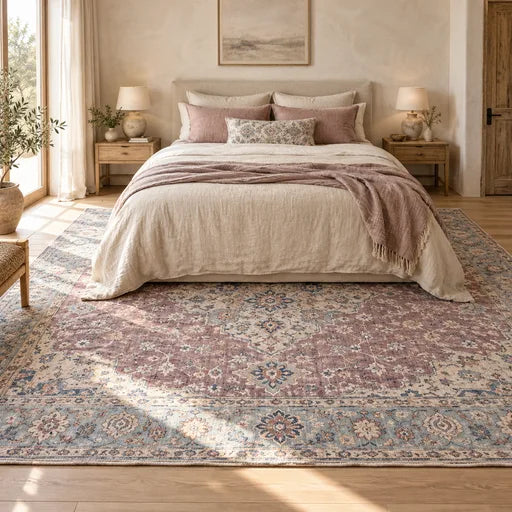
Choose a rug that leaves a clear border of carpet around the edge, around 30 to 45 cm (12 to 18 in) or more, so it looks layered on purpose. A rug that nearly touches the wall looks like a mistake on top of carpet. Our guide to layering rugs explains how to combine colours and sizes, and the medium rugs and large rugs collections show typical sizes.
How do you care for a vintage rug that sits on a pad?
Lift the rug every few months, vacuum both sides of the pad, and let the rug breathe. Trapped moisture is the biggest risk with any pad. Our guide to caring for a vintage wool rug covers vacuuming, spills and rotating.
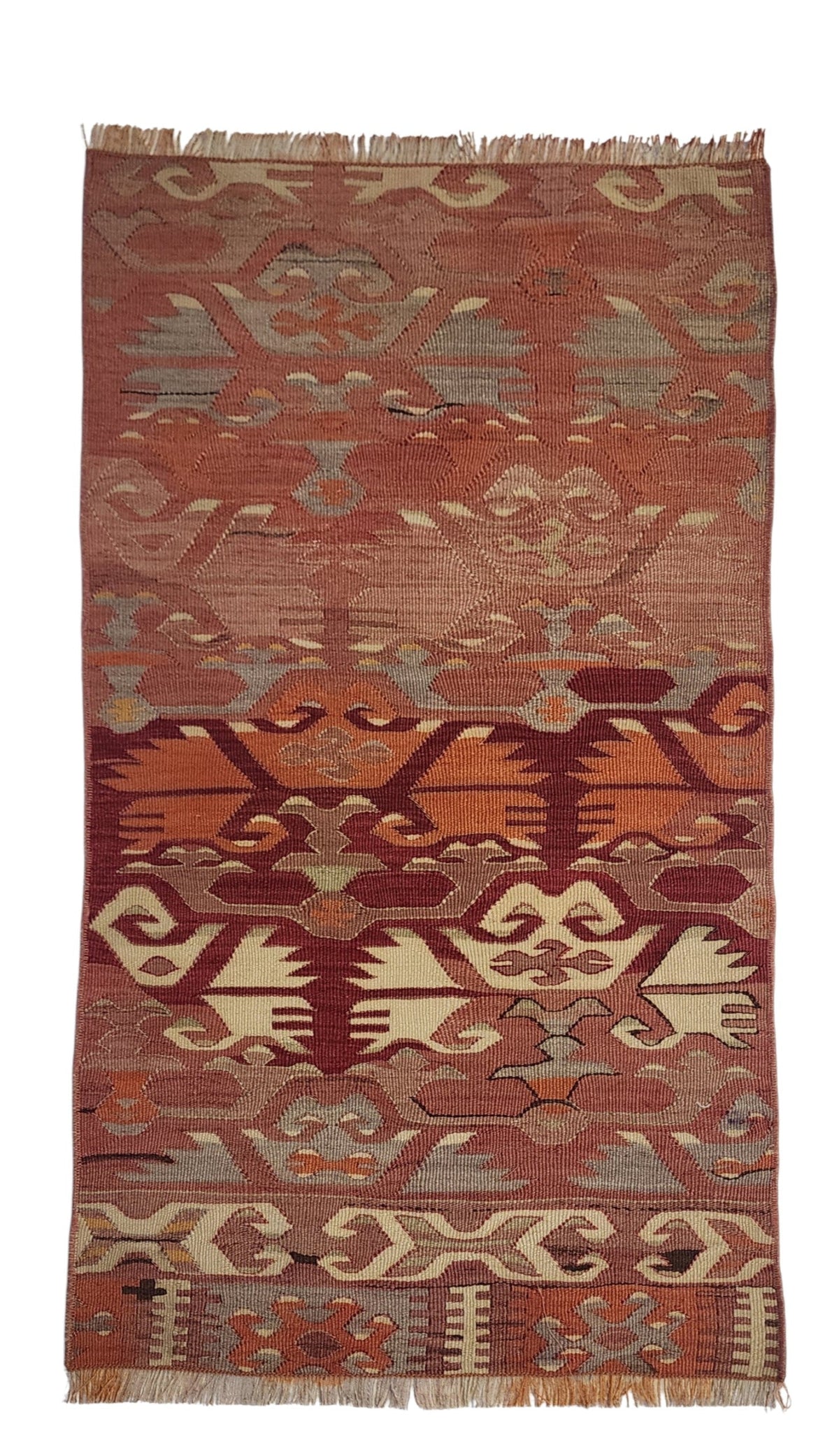
When you are ready to choose, we ship every hand-made rug free worldwide with duties pre-paid for the US, UK, EU and Canada. You can start with a flat-woven piece such as this vintage Afyon kilim, 2 x 3 ft.
Pieces from our collection
Every piece below is one of a kind and in stock today:
- Walanni — Vintage Afyon Kilim Rug, 2x3
- Telesilla — Vintage Konya Wool Large Area Rug
- Marsya — Vintage Anatolian Wool Large Area Rug
Frequently asked questions
Can you put a rug on carpet without a pad?
You can, but the rug will usually creep and wrinkle as people walk on it, especially a thin kilim. A slim, grippy pad keeps it flat and reduces wear on the rug's back. Without one, check the corners and smooth the rug often.
How thick should a rug pad be on carpet?
Keep it thin, around 1/8 in (3 mm) or less. The carpet already provides cushioning, and a thick pad on top makes the rug feel bouncy and can cause bunching. On hard floors, 1/4 in (6 mm) is a common choice.
Should a rug pad be the same size as the rug?
No. Make it about 1 in (2.5 cm) smaller on each side so the edges are hidden and nobody trips over them. Most pads can be cut with sharp scissors or a utility knife on a flat surface.
Will a rug pad damage my carpet?
A suitable pad generally will not. Avoid cheap PVC or vinyl pads, which can stain or leave a residue, and keep everything dry. Vacuum under the pad and shift the rug occasionally so the carpet is not compressed in one place.
Written by the team at Heritage Nomadic Art Gallery in Sultanahmet, Istanbul, the gallery behind TurkishRug.com, where every rug and pillow is chosen, washed and photographed by hand. Last updated October 22, 2026.
%20or%20thinner%20and%20made%20of%20natural%20rubber%20mesh%20or%20a%20slim%20felt-and-rubber%20blend.%20Cut%20it%20about%201%20in%20(2.5%20c...)